Choosing the right portable power station for overlanding means balancing capacity, charging speed, and portability without overpacking your rig.
Below, we focus on practical options that can handle phones, cameras, fridges, lights, and other camp essentials with less guesswork.
Best 10 Portable Power Station for Overlanding Picks for 2026
Compact 1kWh Fast-Charger

- 1,070Wh capacity with 1,500W AC output
- 23.8 lb design is easier to move for overlanding
- 1-hour emergency charging and app control
Best For: Overlanders who want a compact, fast-charging power station
Expandable Heavy-Duty Pick

- 2,000W output with 4,500W surge
- Expands from 1,024Wh to 5,120Wh
- 0-80% AC recharge in 36 minutes
Best For: Overlanders who want high power and modular expansion
Ultra-Compact DC Travel Pack

- 288Wh LiFePO4 pack with 300W DC output
- Very small and light at 2.58 kg
- Five DC ports with fast USB-C recharging
Best For: Lightweight overlanders running mostly DC gear
High-Capacity Quiet Backup

- 2,042Wh capacity with 2,200W output
- Under-30dB silent charging mode
- 20ms UPS switching for critical gear
Best For: Overlanders needing quiet, high-capacity backup power
Ultra-Compact 2kWh Backup Pick
Anker SOLIX S2000 Portable Power Station
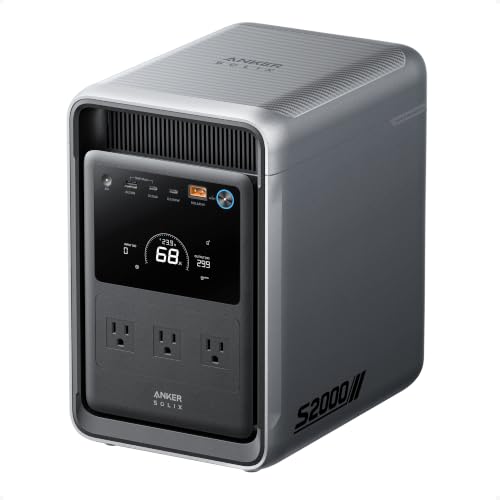
- 2,010Wh LiFePO4 battery with long fridge runtime
- Compact 2kWh design is smaller and lighter than average
- 6 recharge methods, including solar and car charging
Best For: Overlanders who need efficient fridge backup in a smaller 2kWh station
Fast-Charge Mid-Size Choice
BLUETTI AC180 Portable Power Station

- 1,152Wh LiFePO4 battery with about 1-hour AC charging
- 1,800W output with 2,700W boost for tougher loads
- 500W solar input and 20 ms UPS support
Best For: Overlanders who want quick recharging and a versatile mid-size setup
High-Power Wheel-Cart Heavy-Duty Pick
3000W Portable Power Station with Wheels

- 2,560Wh LiFePO4 battery with 3,000W output
- 14 ports and four AC outlets for multi-device setups
- All-terrain wheels and telescopic handle for easier movement
Best For: Overlanders with bigger power needs who want high output and rolling mobility
Fast-Charge Trail Power
Anker SOLIX C1000 for RVs & Camping

- 1056Wh LiFePO4 battery with 1800W output
- Full recharge in under an hour with UltraFast AC charging
- 15% smaller than comparable 1kWh units
Best For: Overlanders who want fast charging and a compact 1kWh-class power station
Ultralight Camp Backup
BLUETTI Elite 30 V2 for Road Trips

- 9.4 lb body with 288Wh capacity
- 600W continuous output and 1500W lifting mode
- 0-80% recharge in 45 minutes on AC
Best For: Minimalist overlanders who want a lightweight station for smaller devices
Heavy-Duty Expedition Power
AFERIY P210 for Extended Trips

- 2048Wh LiFePO4 battery with 2400W output
- Supports up to 16 devices at once
- 48.5 lb build favors capacity over portability
Best For: Extended off-grid overlanding where runtime and device count matter most
Compact 1kWh Fast-Charger – Jackery Explorer 1000 v2
If you want a portable power station for overlanding that stays reasonably compact while still handling real camp loads, the Jackery Explorer 1000 v2 is built for that middle ground. Its 1,070Wh capacity, 1,500W AC output, and 23.8 lb weight make it easier to move than larger backup units, while still giving you enough output for fridges, small appliances, and multiple devices.
Best For: Overlanders who want a lightweight 1kWh-class station with fast charging and strong AC output.
Pros:
- 1,500W continuous AC output with 3,000W surge for small appliances and fridges
- 1,070Wh LiFePO4 battery rated for over 4,000 cycles and long service life
- 1-hour emergency recharge with app control, plus a quiet overnight charging mode
- Multiple outputs including two USB-C ports, USB-A, DC car port, and three AC ports
Cons:
- Solar charging is limited to Jackery-compatible panels only
- Full 1-hour charging requires enabling emergency charging in the app
The Explorer 1000 v2 is a practical pick if you need real campsite power without jumping to a bulky high-capacity unit. It is especially appealing for overlanding setups that value fast recharge times, quiet operation, and a manageable carry weight.
Expandable Heavy-Duty Pick – OUPES Mega 1 2000W
The OUPES Mega 1 is a strong choice for a portable power station for overlanding if your setup needs more output and room to grow. It delivers 2,000W continuous power, a 1,024Wh LiFePO4 battery, and expansion support up to 5kWh, so it can cover everything from camp electronics to larger gear as your power demands increase.
Best For: Overlanders who want high AC output, very fast charging, and expandable capacity.
Pros:
- 2,000W continuous output with 4,500W surge for demanding loads
- Fast recharge speeds: 0-80% in 36 minutes on AC, or 26 minutes with AC plus solar
- Expandable to 5,120Wh with up to two B2 extra batteries
- <20ms UPS transfer time for keeping critical devices running during outages
Cons:
- More power and expansion add complexity compared with simpler compact units
- At 1,024Wh, the base capacity may still be modest for very long off-grid trips without add-ons
This model makes sense when you want more than a basic campsite battery and prefer a system you can scale later. For overlanding rigs that may eventually need serious output and quick turnaround charging, it stands out as the most expandable option here.
Ultra-Compact DC Travel Pack – EcoFlow TRAIL 300 DC
If your overlanding style favors light packing and DC-powered essentials, the EcoFlow TRAIL 300 DC is a very compact portable power station for overlanding. With 288Wh of LiFePO4 capacity, 300W DC output, and a small 5.95 x 6.47 x 3.72 inch footprint, it is designed for travel when you only need the basics powered efficiently.
Best For: Lightweight overlanders who mainly run DC gear and want a minimal carry.
Pros:
- Extremely compact and lightweight at 2.58 kg
- 300W pure DC output with up to 140W per port
- Five output ports, including two USB-C PD ports and a 12V car port
- Fast recharging options via car, solar, or dual USB-C input
Cons:
- No AC outlet is included, so it will not suit AC-powered appliances
- 288Wh capacity is best for essentials rather than larger camp loads
For overlanders who prioritize portability over whole-camp power, this unit is easy to justify. It is best viewed as a compact DC companion for coolers, phones, and other essential travel gear rather than a full campsite power hub.
High-Capacity Quiet Backup – Jackery Explorer 2000 v2
For overlanders who need a larger portable power station for overlanding, the Jackery Explorer 2000 v2 brings 2,042Wh of LiFePO4 capacity and a 2,200W AC output in a package that is still relatively manageable at 39.5 lb. It is aimed at users who want strong runtime for camping, vehicle-based trips, or backup use without jumping to a gas generator.
Best For: Overlanders who want high capacity, quiet charging, and strong AC performance.
Pros:
- 2,042Wh capacity and 2,200W output for bigger loads
- Fast charging options include 0-80% in 66 minutes and full charge in 102 minutes with app-enabled emergency charging
- Silent charging mode runs at under 30dB for low-noise use
- 20ms UPS switching helps keep essentials powered during interruptions
Cons:
- Heavier than smaller overlanding-friendly options at 39.5 lb
- Solar charging speed depends on using 400W panels
This is the pick for trips where power needs are closer to home-backup territory but you still want an off-grid friendly form factor. It balances capacity, output, and quiet operation well for extended camping or overlanding basecamp setups.
Ultra-Compact 2kWh Backup Pick – Anker SOLIX S2000 Portable Power Station
If you want a portable power station for overlanding that can handle longer stays without taking over your cargo space, the Anker SOLIX S2000 is built around efficient 2kWh backup in a surprisingly compact body. It pairs 2,010Wh of LiFePO4 storage with 1,500W continuous output, plus multiple recharge options including solar, car, alternator charger, and wall power.
Best For: Overlanders who want a compact, long-runtime station for fridges, essentials, and mixed charging methods.
Pros:
- 2,010Wh LiFePO4 battery with up to 35-hour fridge backup claimed.
- 30% smaller and 25% lighter than the industry average for a 2kWh class unit.
- 1,500W continuous output and 3,000W peak cover many everyday essentials.
- Supports 6 recharge methods, including up to 400W solar input.
Cons:
- No 12V DC port, which may matter for some overlanding setups.
- At 35.7 lbs, it is still a substantial carry even if it is lighter than many rivals.
- Lower output than larger 3,000W-class stations.
For overlanding, this model makes the most sense if you value runtime, footprint, and charging flexibility over sheer output. It is a strong fit for fridge duty and core campsite power, especially when you want cleaner organization with front and rear outlet placement.
Fast-Charge Mid-Size Choice – BLUETTI AC180 Portable Power Station
The BLUETTI AC180 is a practical portable power station for overlanding when you want a balanced mix of capacity, output, and very fast recharging. Its 1,152Wh LiFePO4 battery, 1,800W output, and 8 outlets make it useful for camping loads, while the 500W solar input and rapid AC charging help it get back into service quickly.
Best For: Overlanders who prioritize quick recharge times and a versatile mid-size power station.
Pros:
- Fully charges in about 1 hour with 1,440W AC input.
- 1,800W output with 2,700W boost for higher-demand devices.
- 500W solar input supports fast solar charging on the trail.
- 20 ms UPS function adds backup protection for essential gear.
Cons:
- Smaller 1,152Wh capacity than larger overlanding-focused units.
- At 37.4 lbs, it is not especially light for frequent moving.
- Best performance depends on using the AC boost or high-input charging options.
For overlanders who move often and want a station that can recharge quickly between stops, the AC180 is easy to justify. It is a strong middle-ground option if you need reliable power without stepping up to a much larger 2kWh-plus system.
High-Power Wheel-Cart Heavy-Duty Pick – 3000W Portable Power Station with Wheels
If your portable power station for overlanding needs to run bigger appliances and still move easily around camp, this 3,000W model leans hard into high output and mobility. It combines a 2,560Wh LiFePO4 battery with 3,000W continuous output, 5,000W peak power, 14 output ports, and luggage-style telescopic handling with all-terrain wheels.
Best For: Overlanders who need high wattage, many ports, and easy rolling transport for heavier rigs.
Pros:
- 3,000W output and 5,000W peak power handle demanding gear.
- 2,560Wh LiFePO4 battery with 4,000+ cycles and 10-year life claim.
- 14 output ports, including four AC outlets and 100W USB-C ports.
- All-terrain wheels and telescopic handle improve camp-to-camp mobility.
Cons:
- At 75 lbs, it is much heavier than smaller overlanding power stations.
- 1.6-hour full charge is fast, but the unit is still physically large.
- Solar panels are sold separately.
This is the strongest option in the group if output matters more than portability in the carry-in sense. For larger overlanding builds, RV-style camping, or setups with heavy AC loads, the added ports and wheeled design make it especially practical.
Fast-Charge Trail Power – Anker SOLIX C1000 for RVs & Camping
If you want a portable power station for overlanding that can keep up with frequent stops and fast turnarounds, the Anker SOLIX C1000 is built around speed and flexibility. Its 1056Wh LiFePO4 battery, 1800W output, and 11 ports make it a strong fit for charging cameras, lights, a fridge, and other trip essentials, while UltraFast recharging helps it get back on the road quickly.
Best For: Overlanders who need a compact 1kWh-class station with very fast AC charging and solid appliance support.
Pros:
- Full recharge in under an hour with UltraFast AC charging
- 2400W SurgePad output supports a wide range of gear
- 15% smaller than comparable 1kWh units for easier packing
- Up to 600W solar input for off-grid recharging
Cons:
- Heavier than ultra-compact small-capacity units at 27.6 lb
- Fast charging requires use of the app and a smartphone
- Best fit for moderate loads rather than very long off-grid runtimes
For overlanding setups that value quick recharge times and a balanced size-to-output ratio, the SOLIX C1000 is a practical middle ground. It’s especially appealing if you want dependable power without moving up to a much larger and heavier station.
Ultralight Camp Backup – BLUETTI Elite 30 V2 for Road Trips
The BLUETTI Elite 30 V2 is a portable power station for overlanding when weight matters most. At 9.4 lb with 288Wh of capacity, it is easy to move between camp, the vehicle, and short stops, while still offering 600W continuous output and a 1500W lifting mode for small appliances and essential electronics.
Best For: Minimalist overlanders and road-trippers who want a lightweight station for lights, charging, and smaller devices.
Pros:
- Very light at 9.4 lb for easy carry and setup
- 600W output with 1500W power lifting for short bursts
- 0-80% recharge in 45 minutes on AC input
- 10ms UPS helps protect critical devices during outages
Cons:
- 288Wh capacity is limited for longer off-grid use
- Best suited to smaller electronics rather than high-draw gear
- Not the right choice if you need long runtime between charges
If you pack light and prioritize portability over total capacity, this BLUETTI makes sense for quick trips and backup use. It’s a compact, efficient option when your overlanding power needs stay modest.
Heavy-Duty Expedition Power – AFERIY P210 for Extended Trips
For longer overlanding runs, the AFERIY P210 brings a much larger 2048Wh battery and 2400W output, making it a strong portable power station for overlanding when you need more runtime and more headroom. It also supports up to 16 devices, includes a 12V/25A XT60 DC output, and uses pure sine wave AC input and output for sensitive electronics.
Best For: Overlanders planning extended off-grid stays who need higher capacity and broader device support.
Pros:
- Large 2048Wh LiFePO4 battery for extended use
- 2400W inverter with 4800W surge capacity
- Up to 16 devices can charge at once
- Sub-10ms UPS response for critical backup needs
Cons:
- At 48.5 lb, it is far less convenient to move around
- Bulkier than compact camping-focused stations
- May be more power than you need for short weekend trips
If your overlanding setup includes heavier electrical demands or longer time away from charging sources, the P210 offers serious capacity and flexibility. It’s the most expedition-ready option here, especially if you value runtime over portability.
How We Picked the Best Portable Power Station for Overlanding
We prioritized real-world overlanding needs: enough battery capacity for overnight or weekend use, strong AC and DC output for common gear, fast recharging from shore power or solar, and durable battery chemistry such as LiFePO4. We also looked at weight, portability features, and whether each unit suits a compact SUV setup, truck bed build, or basecamp-style camp.
Quick Comparison
Smaller units are best for light-duty charging, short trips, and minimalist builds. Mid-size models tend to offer the best balance for most travelers, especially if you run a 12V fridge, device charging, and lights. Large-capacity units are better when you want longer runtime, higher appliance output, or fewer recharge stops between destinations.
Key Buying Factors for a Portable Power Station for Overlanding
Battery Capacity and Runtime
Look at watt-hours first. Higher Wh means more runtime, but also more size and weight. For a Portable Power Station for Overlanding, the right capacity depends on whether you only charge electronics or also power a fridge, CPAP, drone batteries, or cooking accessories.
Output and Port Selection
Check both continuous wattage and surge wattage. Make sure the station has the right mix of AC outlets, 12V/DC outputs, USB-C PD, and any specialty ports your gear requires. For many overlanders, strong DC output is especially useful because it can be more efficient than running everything through AC.
Charging Speed and Solar Support
Fast AC charging is valuable when you have access to grid power between trips. Solar input matters if you camp longer or want a quieter recharge option. Matching the station to your panel size helps avoid bottlenecks and reduces downtime.
Portability and Setup Style
If you move camp often, lighter units and compact handles matter more than maximum capacity. If the power station will stay in the vehicle or trailer most of the time, weight becomes less important than runtime and outlet count.
Battery Chemistry and Longevity
LiFePO4 batteries are generally the best fit for overlanding because they offer strong cycle life and good thermal stability. That makes them a smart choice for frequent travel and repeated charging.
Who Should Buy Which Portable Power Station for Overlanding?
Choose a compact model if you want simple power for phones, tablets, cameras, and lights. Pick a mid-range unit if you run a portable fridge and want a flexible everyday setup. Go with a high-capacity, higher-wattage option if you need longer off-grid stays, multiple appliances, or a more complete camp power solution. For most buyers, the best Portable Power Station for Overlanding is the one that matches your actual load, not the biggest number on the box.