Finding intermittent electrical faults requires more than a basic multimeter. The best automotive oscilloscopes for diagnostics reveal changing signals from sensors, actuators, ignition systems, and communication circuits.
This roundup includes USB scopes, handheld multifunction instruments, circuit-testing tools, and practical diagnostic guides, helping you match the equipment to your vehicle work, experience level, and budget.
Best 10 Automotive Oscilloscopes for Diagnostics Picks for 2026
Best Multi-Channel Value
Hantek 1008C Automotive Diagnostic Oscilloscope

- Eight analog channels for simultaneous testing
- More than 80 automotive diagnostic functions
- Programmable 0–250 kHz signal generator
Best For: Windows-based multi-signal automotive troubleshooting
Best All-in-One Circuit Probe
VDIAGTOOL V500 Pro Automotive Tester

- Combines oscilloscope and multimeter functions
- Traces opens, shorts, and broken wires
- Tests injectors, relays, fuses, and components
Best For: Broad automotive electrical troubleshooting
Best Portable Option
FNIRSI DSO-510 Handheld Oscilloscope

- 10 MHz bandwidth with 48 MS/s sampling
- Built-in battery and Type-C charging
- DDS generator with 13 waveform types
Best For: Portable waveform testing and signal simulation
Best Complete Hantek Kit
Hantek 1008C Automotive Scope Bundle
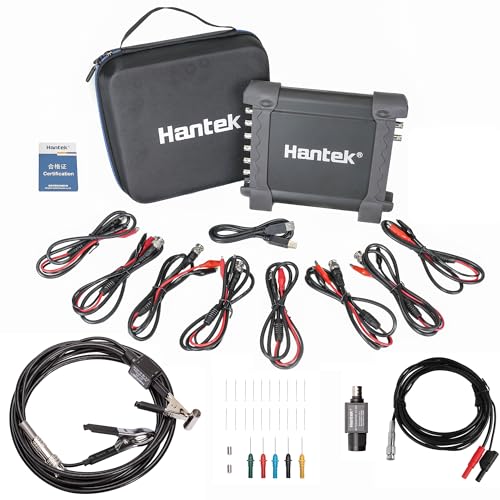
- Eight-channel automotive diagnostic platform
- Includes more than 80 automotive test functions
- Adds multiple accessories and eight cables
Best For: A ready-to-use Windows-based automotive scope kit
Best All-in-One Pick
FNIRSI 2C53P 3-in-1 Oscilloscope

- Two-channel scope with 250 MS/s sampling and 50 MHz bandwidth
- Built-in multimeter and 12-waveform DDS signal generator
- Touchscreen, FFT analysis, and rechargeable 4000 mAh battery
Best For: Portable, multifunction automotive electrical testing
Best for Multi-Channel Diagnostics
Hantek 6074BE 4-Channel USB Scope

- Four channels with 1GSa/s sampling and 70 MHz bandwidth
- Preset tests for more than 80 automotive inspection items
- USB computer-based design with automated measurements and PASS/FAIL checks
Best For: Workshop diagnostics requiring simultaneous signal testing
Best Learning Guide
Mastering Automotive Oscilloscope Diagnostics

- Explains practical waveform capture and analysis
- Covers sensors, actuators, ignition, fuel, and intermittent faults
- Helps build a structured diagnostic workflow
Best For: Learning how to apply oscilloscope testing in vehicle diagnostics
Best Multi-Channel Pick
Hantek 1008C Automotive Oscilloscope

- Eight channels for vehicle testing
- More than 80 automotive diagnostic functions
- Report, screenshot, and data-saving tools
Best For: Workshops and DIY users needing extensive channel capacity
Best Beginner Guide
Automotive Oscilloscope Diagnostics Made Simple

- Step-by-step setup and waveform instruction
- Covers sensors, ignition, CAN, and EV systems
- Includes three practical case studies
Best For: New users learning waveform-based vehicle diagnosis
Best Workflow Reference
Automotive Oscilloscope Diagnostics Handbook

- Focuses on stable waveform capture
- Covers sensors, actuators, and charging circuits
- Explains wiring and intermittent-fault clues
Best For: Technicians building a repeatable waveform diagnostic process
Best Multi-Channel Value – Hantek 1008C Automotive Diagnostic Oscilloscope
The Hantek 1008C is a practical choice for buyers seeking automotive oscilloscopes for diagnostics with broad channel coverage. Its eight analog channels, automotive test library, automatic measurements, and programmable signal generator support tasks ranging from sensor and ignition checks to crankshaft and camshaft signal simulation.
Best For: Technicians, electricians, and hobbyists who want a Windows-based, USB-connected oscilloscope for multi-signal automotive and general electronics troubleshooting.
Pros:
- Eight channels with 12-bit resolution and 4K memory depth
- Includes more than 80 automotive diagnostic functions
- Programmable signal generator covers 0–250 kHz and can simulate crankshaft and camshaft signals
- Offers 20 selectable automatic measurement modes
Cons:
- Requires a Windows PC and USB connection for operation
- Its 2.4 MSa/s real-time sampling rate may not suit every high-speed measurement task
Choose this model when channel count and automotive-specific functions matter more than standalone portability. It is especially useful for users comfortable working from a Windows computer.
Best All-in-One Circuit Probe – VDIAGTOOL V500 Pro Automotive Tester
The VDIAGTOOL V500 Pro combines oscilloscope functions with several hands-on electrical testing tools, making it a versatile option among automotive oscilloscopes for diagnostics. It can display voltage signals, trace wiring faults, test injectors and relays, activate components, and provide adjustable low-voltage output for circuit testing.
Best For: Technicians and DIYers who want one automotive electrical tester for waveform viewing, multimeter measurements, wire tracing, injector checks, and component activation.
Pros:
- Combines oscilloscope and multimeter modes with voltage, resistance, diode, current, frequency, and polarity tests
- Designed to locate open circuits, shorts, broken wires, and wiring faults
- Includes injector, relay, fuse, and component-activation testing
- Provides adjustable 0–5 V power for sensor and low-power circuit diagnosis
Cons:
- The supplied notes do not specify oscilloscope bandwidth or sampling rate
- Its wide feature set may be more than needed for users seeking a dedicated oscilloscope
This is a strong fit for electrical troubleshooting workflows where waveform analysis is only one part of the job. Its integrated probe-style functions can reduce the need to switch among separate test tools.
Best Portable Option – FNIRSI DSO-510 Handheld Oscilloscope
The FNIRSI DSO-510 is a compact 2-in-1 instrument for buyers who prioritize portability in automotive oscilloscopes for diagnostics. It offers a 10 MHz oscilloscope, 48 MS/s sampling, a DDS signal generator, automatic setup, waveform capture features, and a rechargeable battery in a handheld format.
Best For: Mobile technicians, hobbyists, and users who need a small general-purpose oscilloscope with signal-generation capability for suitable automotive and electronic tests.
Pros:
- Handheld design with a built-in 1000 mAh lithium battery
- 10 MHz bandwidth and 48 MS/s sampling rate
- DDS generator outputs 13 waveform types up to 50 kHz
- Supports automatic setup, infinite afterglow, waveform scaling, and image export
Cons:
- It is a general-purpose handheld scope rather than a dedicated automotive diagnostic platform
- The 2.8-inch, 320 × 240 display is compact
- The supplied notes do not list automotive-specific diagnostic functions
Consider the DSO-510 when easy transport and quick waveform inspection are more important than a built-in automotive test library. Its signal generator and battery operation add flexibility for bench or field work.
Best Complete Hantek Kit – Hantek 1008C Automotive Scope Bundle
This Hantek 1008C bundle delivers the same eight-channel automotive platform as the base unit while adding HT201, HT30A, HT25, HT307, and eight cables. For buyers comparing automotive oscilloscopes for diagnostics, the included accessories can make it a more ready-to-use package for sensor, ignition, bus, actuator, starting, and charging checks.
Best For: Technicians and serious hobbyists who want an eight-channel Windows PC oscilloscope with a broader supplied accessory set.
Pros:
- Eight analog channels with 12-bit resolution and 4K memory depth
- Includes more than 80 automotive diagnostic functions
- Programmable 0–250 kHz signal generator supports crankshaft and camshaft simulation
- Bundle includes multiple accessories and eight cables
Cons:
- Requires a Windows PC and USB connection
- The supplied notes identify the scope as the Hantek 1008C, so core performance is similar to the standalone version
- Its 2.4 MSa/s real-time sampling rate may be limiting for some faster signals
This bundle is worth considering when included accessories are more valuable than purchasing the basic scope alone. It retains the Hantek platform’s strong channel count and automotive coverage while expanding the starting kit.
Best All-in-One Pick – FNIRSI 2C53P 3-in-1 Oscilloscope
For shoppers comparing automotive oscilloscopes for diagnostics, the FNIRSI 2C53P combines a two-channel oscilloscope, multimeter, and DDS signal generator in a compact handheld design. Its 250 MS/s sampling rate, 50 MHz bandwidth, one-key AUTO function, and waveform analysis tools make it versatile for general electrical and automotive troubleshooting.
Best For: Technicians and DIYers who want several testing functions in one portable instrument.
Pros:
- Combines a two-channel oscilloscope, 19999-count multimeter, and signal generator.
- Includes X-Y mode, FFT spectrum analysis, waveform storage, and export support.
- Features a 4.3-inch IPS touchscreen and a 4000 mAh rechargeable battery.
Cons:
- Its approximately four-hour battery life may require recharging during extended work.
- Two channels provide less simultaneous coverage than four-channel diagnostic scopes.
The 2C53P is a strong choice when portability and multifunction capability matter more than maximum channel count. It is especially practical for mixed electrical work where a dedicated meter and signal generator would otherwise require separate tools.
Best for Multi-Channel Diagnostics – Hantek 6074BE 4-Channel USB Scope
Hantek 6074BE Digital Oscilloscope 70MHz 1GSa/s 4CH USB Virtual Oscilloscope Diagnostic Tool
Check Price On AmazonThe Hantek 6074BE is aimed directly at automotive oscilloscopes for diagnostics, with four channels, 70 MHz bandwidth, and a 1GSa/s real-time sampling rate. Its computer-based USB design supports preset tests for more than 80 automotive items, including ignition, sensors, engine, starting, and charging systems.
Best For: Automotive technicians who need multiple simultaneous channels and structured diagnostic test functions.
Pros:
- Offers four channels, 70 MHz bandwidth, and 1GSa/s real-time sampling.
- Includes automotive preset modes covering more than 80 inspection items.
- Provides over 20 automatic measurements, PASS/FAIL checks, waveform replay, and trigger functions.
- Combines oscilloscope, multimeter, waveform generator, and tester functions in one USB instrument.
Cons:
- Requires a Windows-compatible computer and USB connection rather than operating as a standalone handheld scope.
- Its corded USB setup is less convenient where a built-in battery is preferred.
Choose the Hantek when channel count and automotive-oriented workflows are priorities. The computer-dependent format is less pocketable, but it supports detailed viewing, automated measurements, and repeatable testing in a workshop or mobile laptop setup.
Best Learning Guide – Mastering Automotive Oscilloscope Diagnostics
Not a scope itself, this practical guide complements automotive oscilloscopes for diagnostics by explaining how to capture and interpret vehicle waveforms. It focuses on sensors, actuators, control circuits, ignition, fuel, engine performance, intermittent faults, and comparing known-good signals with faulty ones.
Best For: Technicians, auto electricians, workshop owners, and serious DIYers building waveform-analysis skills.
Pros:
- Emphasizes practical waveform capture and interpretation rather than theory alone.
- Covers sensor, actuator, ignition, fuel, engine, and intermittent electrical fault diagnosis.
- Promotes a structured workflow intended to reduce guesswork and repeat repairs.
Cons:
- It is an 82-page book, not an oscilloscope or testing instrument.
- Its usefulness depends on having access to suitable diagnostic equipment for applying the techniques.
This is a useful companion purchase for anyone who already owns, or plans to buy, a scope. It can help turn waveform testing into a repeatable diagnostic process, but it cannot replace hands-on equipment or vehicle-specific test information.
Best Multi-Channel Pick – Hantek 1008C Automotive Oscilloscope
Hantek 1008C PC USB 8CH Automotive Diagnostic Digital Oscilloscope/DAQ/Programmable Generator
Check Price On AmazonFor technicians comparing automotive oscilloscopes for diagnostics, the Hantek 1008C stands out for its eight-channel design and broad set of vehicle-focused functions. It is a Windows-based, corded USB unit intended for testing ignition, sensors, buses, starting, and charging circuits, with tools for saving and reporting results.
Best For: Workshops and experienced DIY users who need multiple channels and dedicated automotive test functions.
Pros:
- Eight channels support simultaneous vehicle signal testing.
- Includes more than 80 automotive diagnostic functions.
- Can save data, capture screenshots, and generate or print diagnostic reports.
- Includes an auto probe, four alligator-clip coaxial cables, and four coaxial connectors.
Cons:
- Requires a Windows XP operating system according to the supplied specifications.
- Corded USB operation is less convenient than a standalone handheld scope.
- The listed manufacturer warranty is 90 days.
The Hantek 1008C is a feature-rich choice when channel count and automotive-specific coverage matter more than portability. Verify computer compatibility before buying.
Best Beginner Guide – Automotive Oscilloscope Diagnostics Made Simple
For readers researching automotive oscilloscopes for diagnostics, this 111-page guide focuses on learning waveform testing rather than buying hardware. It uses step-by-step instructions to explain setup, waveform interpretation, sensor and actuator testing, and practical fault-finding across several scope platforms.
Best For: Beginners, students, DIY mechanics, and workshop technicians who want a practical introduction to waveform diagnostics.
Pros:
- Explains scope setup, channel configuration, and safe probe connections.
- Covers sensors, actuators, fuel and ignition systems, and CAN bus networks.
- Includes guidance on math channels, FFT analysis, and serial decoding.
- Provides three real-world diagnostic case studies and hybrid/EV topics.
Cons:
- It is an instructional book, not an oscilloscope or diagnostic tool.
- Image placeholders are mentioned rather than supplied as confirmed illustrations.
- The supplied edition is dated July 21, 2026, so availability may vary by publication timing.
This is a useful companion for someone who already owns a compatible scope and needs a structured learning path. Its broad platform coverage makes it more flexible than a guide tied to one brand.
Best Workflow Reference – Automotive Oscilloscope Diagnostics Handbook
Among resources for automotive oscilloscopes for diagnostics, this 158-page handbook emphasizes repeatable testing and evidence-based fault confirmation. It focuses on practical scope settings, stable captures, and interpreting voltage, frequency, duty cycle, current ramps, ripple, and signal behavior.
Best For: Mechanics, auto electricians, serious DIYers, and technicians sharpening their waveform-testing process.
Pros:
- Explains how to capture stable, usable waveforms.
- Covers crank, cam, wheel-speed, throttle, pressure, temperature, and position sensors.
- Addresses injectors, ignition coils, relays, solenoids, starting, and charging circuits.
- Connects waveform clues with wiring faults, voltage drop, poor grounds, and intermittent problems.
Cons:
- It is a reference book rather than a physical oscilloscope.
- The supplied description does not specify brand-specific setup instructions.
- Its 6-by-9-inch format may provide less room for diagrams or notes than a larger manual.
This handbook is a strong fit for readers who want a systematic diagnostic workflow and broader circuit coverage. It complements an existing scope by focusing on how to interpret evidence and confirm faults.
How We Picked the Best Automotive Oscilloscopes for Diagnostics
We evaluated the selected products by considering their diagnostic usefulness, channel count, bandwidth, sampling capability, portability, included accessories, and overall learning curve. Because the list includes both instruments and automotive oscilloscope books, we separated hardware capabilities from educational value rather than treating every product as a direct substitute.
For automotive work, a useful scope should make changing electrical signals easy to capture and interpret. We also considered whether a product is better suited to a fixed workshop computer, mobile troubleshooting, general electronics, or structured waveform-learning.
Quick Comparison
| Type | Best for | Main advantage | Potential limitation |
|---|---|---|---|
| USB automotive scope | Workshop diagnostics | Multiple channels and computer display | Requires a compatible computer |
| Handheld multifunction scope | Mobile testing | Portable, often combines meter and generator functions | May have fewer automotive-specific accessories |
| Circuit tester | Fast power and continuity checks | Simple, immediate troubleshooting | Not a replacement for waveform analysis |
| Diagnostic guide | Learning waveform interpretation | Builds testing and analysis skills | Provides no measurement hardware |
Key Buying Factors for Automotive Oscilloscopes for Diagnostics
Channels and Bandwidth
Two channels can handle many basic comparisons, such as crankshaft and camshaft signals. Four or more channels are more useful when checking related inputs and outputs at the same time. Bandwidth should comfortably cover the signals you expect to test, while higher sampling rates help preserve fast transitions and short glitches.
Connection and Portability
USB models typically offer a larger display, recording tools, and easier file storage, but they depend on a laptop or desktop. Handheld models are quicker to use at the vehicle and are better for mobile technicians. Check whether the package includes suitable probes, clips, leads, and protective accessories.
Electrical Safety
Confirm the instrument’s input limits, grounding arrangement, and probe ratings before connecting it to a vehicle. Automotive circuits can produce voltage spikes, especially around ignition, injectors, motors, and inductive loads. Use appropriate attenuation and follow the manufacturer’s connection guidance.
Software and Learning Support
PC scopes are only as useful as their software. Look for stable drivers, waveform storage, measurement tools, and trigger controls. If you are new to scope work, a practical guide can shorten the learning curve by explaining expected patterns and test procedures.
Who Should Buy Which Automotive Oscilloscopes for Diagnostics?
Choose a multi-channel USB automotive scope if you work regularly in a workshop and want detailed comparisons, recording, and a large screen. Choose a handheld multifunction model if portability and quick roadside checks matter more than maximum channel count. A dedicated circuit tester is appropriate for preliminary power, ground, open, and short-circuit checks, but it should complement—not replace—a real oscilloscope.
Beginners should consider pairing capable hardware with a waveform-analysis handbook or step-by-step diagnostic guide. Experienced technicians may prioritize channel count, bandwidth, trigger flexibility, accessories, and software workflow. Before buying, verify compatibility with your computer or operating system and make sure the included leads suit the voltage and connector types found in the vehicles you service.