The best bike front racks for touring make it easier to carry clothing, camping equipment, groceries, and other bulky essentials without placing everything over the rear wheel. The right rack can also improve weight distribution and handling on long rides.
This roundup compares 10 front-rack options, including traditional pannier racks, platform-style cargo racks, and models designed for bikes with fewer mounting points. Check compatibility, claimed capacity, and mounting hardware carefully before choosing.
Best 10 Bike Front Racks for Touring Picks for 2026
Classic Touring Support

- Steel tube construction
- 10 kg load capacity
- Includes 9mm QR skewer
Best For: Touring and cyclocross bikes with canti brake mounts
Universal Heavy-Duty Carrying

- 24.3-pound load capacity
- Rubberized frame-protecting grips
- Adjustable deck and pannier rails
Best For: Heavy-duty rear touring cargo and pannier use
Strap-On Front Versatility

- No eyelets needed
- 22-pound load capacity
- Level-adjustable top plate
Best For: Eyelet-free mountain bike forks and flexible front cargo
Lightweight Essential-Carry Rack

- Aluminum construction
- 6.6-pound cargo capacity
- Head-tube mount
Best For: Light touring, commuting, and recreational essentials
Best Lightweight Classic

- 6061-T6 aluminum construction
- Adjustable struts fit many forks
- 10 kg maximum load
Best For: Light touring, commuting, gravel riding, and bikepacking
Best High-Capacity Option

- 15 kg maximum load
- Adjustable dual support legs
- Fits 26-inch through 700c bikes
Best For: Touring and commuting with heavier front cargo
Best Secure Setup
Strap-Ready Aluminum Cargo Rack

- Includes two adjustable cargo straps
- Adjustable fork-crown positioning
- 10 kg maximum load
Best For: Stable everyday cargo, commuting, and lighter touring
Lightweight Fork-Mount Pick

- Lightweight aluminum alloy construction
- 20-pound load capacity
- Disc-brake version with included hardware
Best For: Touring and commuting on compatible disc-brake bikes
Heavy-Duty Utility Choice

- 15 kg stated load capacity
- Protective side supports for bags
- Fork-hole or cable-tie mounting options
Best For: High-capacity city, mountain, and folding-bike cargo
Versatile Brake-Compatible Option
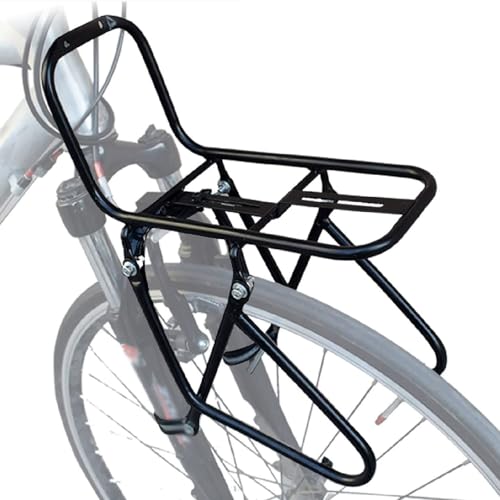
- 15 kg stated load capacity
- Compatible with V-brake and disc-brake systems
- Protective side supports for luggage
Best For: Mountain, road, and folding-bike touring cargo
Classic Touring Support – Minoura FRP-3000
The Minoura FRP-3000 is a front rack option for touring riders who want steel tube construction and a brake-mount installation. It includes a 9mm quick-release skewer and is rated for loads up to 10 kg, making it a practical choice among bike front racks for touring when compatible canti brake mounts are available.
Best For: Touring or cyclocross bikes with compatible canti brake mounts.
Pros:
- Steel tube construction provides a sturdy rack design.
- Includes a 9mm QR skewer for installation.
- Supports up to 10 kg of front cargo.
- Made in Japan.
Cons:
- Mounting is tied to compatible brake mounts.
- At 1.3 kg, it is not the lightest listed option.
The FRP-3000 stands out for its substantial load rating and straightforward brake-mount format. Confirm your bike’s mounting points and wheel compatibility before choosing it.
Universal Heavy-Duty Carrying – Thule Pack 'n Pedal Tour Rack
The Thule Pack ‘n Pedal Tour Rack is a rear frame-mount rack with pannier rails and a 24.3-pound load capacity. Its rubberized grips, adjustable deck, and raised strut mounting points make it a useful touring choice when secure cargo support and heel clearance matter.
Best For: Riders seeking a heavy-duty universal-fit rack with pannier rails and easy installation.
Pros:
- Supports loads up to 24.3 pounds.
- Rubberized grips help prevent sliding and protect the frame.
- Raised strut mounting points improve clearance.
- Adjustable deck and rails provide heel clearance.
Cons:
- This is a rear rack rather than a front rack.
- Its nylon construction and 2.4-pound weight may not suit minimalist setups.
Although it is not a front rack, the Tour Rack is relevant for touring setups that need substantial rear carrying capacity. The light or reflector attachment point is an added visibility benefit.
Strap-On Front Versatility – Topeak TetraRack M1
The Topeak TetraRack M1 is a front fork-mount rack designed for bikes without eyelets. Hook-and-loop straps accommodate a range of bikes, while the independently adjustable top plate helps keep the platform level despite the fork angle. It supports up to 22 pounds for touring essentials.
Best For: Mountain bike riders needing a no-eyelet front rack with flexible strap mounting.
Pros:
- Mounts to forks with hook-and-loop straps.
- Level-adjusting top plate improves platform stability.
- Supports up to 22 pounds.
- Works with specified Topeak, RackTime, and compatible bag systems.
Cons:
- Strap mounting may require careful setup for a secure fit.
- The listed fit is specific to fork widths from 115–145 mm.
The TetraRack M1 is one of the more adaptable bike front racks for touring, particularly for suspension-style or eyelet-free forks. Check the fork width and bag compatibility before purchase.
Lightweight Essential-Carry Rack – ROCKBROS Front Bike Rack
The ROCKBROS Front Bike Rack uses an aluminum construction and head-tube mount for a compact front-carrying solution. With a 6.6-pound capacity, it is suited to lighter touring, commuting, and recreational loads on compatible mountain and road bikes.
Best For: Riders carrying a small amount of essential gear on road or mountain bikes.
Pros:
- Aluminum construction balances durability and low weight.
- Supports up to 6.6 pounds of cargo.
- Designed for mountain and road bike use.
- Black streamlined finish complements the bike.
Cons:
- Lower capacity than the other front-oriented racks listed.
- Head-tube mounting requires compatibility with the bike.
- The supplied listing specifies a 30-day warranty.
The ROCKBROS is best viewed as a light-duty option rather than a full expedition rack. Its modest capacity makes it appropriate for essentials, commuting items, or recreational rides.
Best Lightweight Classic – Compact Aluminum Front Rack
If you need bike front racks for touring that add useful cargo space without a bulky setup, this compact aluminum rack is worth considering. Its adjustable struts fit a range of forks, while the 10 kg capacity suits lighter touring, commuting, and bikepacking loads.
Best For: Riders seeking a compact front rack for touring, gravel riding, mountain biking, or commuting.
Pros:
- Lightweight 6061-T6 aluminum construction.
- Adjustable 11- to 15.35-inch support legs can fit forks without eyelets.
- Compatible with 26- to 29-inch and 700c bicycles.
- Includes mounting bolts, brackets, and instructions.
Cons:
- Maximum load is limited to 10 kg.
- Requires a fork crown mounting point.
- Fasteners should be checked regularly for loosening.
This is a practical choice when you want a small, adjustable cargo platform for lighter loads. Its straightforward mounting design and broad wheel compatibility make it a flexible option for touring setups, though heavier expedition loads call for a higher-capacity rack.
Best High-Capacity Option – Adjustable 15 kg Front Rack
Among bike front racks for touring, this adjustable model stands out for its stated 15 kg capacity. The reinforced 6061-T6 aluminum construction and adjustable dual support legs are designed for carrying larger loads on touring, commuting, and bikepacking rides.
Best For: Tourers and commuters who need more front cargo capacity for bags, water, food, or small baskets.
Pros:
- Supports up to 15 kg while weighing 1.25 kg.
- Adjustable 11- to 15.35-inch struts work with many forks without eyelets.
- Fits 26-inch, 27.5-inch, 29-inch, and 700c bicycles.
- Includes mounting hardware and English instructions.
Cons:
- At 1.25 kg, it may not suit riders prioritizing the lightest possible setup.
- Requires regular checking of fastening screws.
- Specific fork fit should be confirmed before installation.
The higher load rating gives this rack an advantage for riders carrying substantial front cargo. Its adjustable mounting system is versatile, but compatibility still depends on the shape and mounting points of your particular fork.
Best Secure Setup – Strap-Ready Aluminum Cargo Rack
For riders comparing bike front racks for touring, this model focuses on stable cargo carrying and convenient adjustment. It mounts at the fork crown, includes adjustable straps and mounting hardware, and supports up to 10 kg for daily riding, grocery runs, and lighter touring gear.
Best For: Cyclists who want a stable, strap-equipped front rack for touring, commuting, and everyday cargo.
Pros:
- 6061-T6 aluminum construction with a 10 kg load rating.
- Adjustable positioning helps fine-tune height, front, rear, and side placement.
- Includes two adjustable straps for securing cargo.
- Comes with mounting hardware and a built-in hex socket wrench.
Cons:
- Requires fork-crown mounting holes.
- Maximum load is 10 kg.
- Not designed for passengers, children, or child seats.
This rack is a sensible pick when cargo stability and easy adjustment matter more than maximum capacity. The included straps and tool simplify setup, while the fork-crown requirement makes compatibility checking especially important.
Lightweight Fork-Mount Pick – Aluminum Alloy Front Rack
If you want bike front racks for touring that keep added weight low, this aluminum alloy carrier is a practical option for compatible bikes. Its front-fork mount is intended for panniers, baskets, and luggage, while the included hardware kit supports installation.
Best For: Touring and commuting on compatible folding or mountain bikes with disc brakes and suitable fork mounting points.
Pros:
- Lightweight aluminum alloy construction
- Designed for panniers, baskets, and luggage
- Up to 20-pound load capacity
- Includes mounting accessories and tools
Cons:
- Requires compatible front-fork mounting points
- This version is intended for disc-brake bikes; check clearance before ordering
Its low-weight design suits riders who want front cargo support without choosing a heavier steel rack. Confirm the fork mounts, dimensions, and brake setup carefully before purchase.
Heavy-Duty Utility Choice – 15KG Steel Front Rack
For riders comparing bike front racks for touring, this steel carrier emphasizes durability and a 15 kg capacity. Protective side supports help keep bags away from the wheel, and the detachable design can accommodate shopping, picnic, and cargo use.
Best For: City, mountain, and folding-bike riders carrying substantial everyday cargo or touring luggage.
Pros:
- High-strength steel construction with black coating
- 15 kg, or over 33-pound, stated capacity
- Protective side supports help reduce bag-to-wheel contact
- Offers fork-hole or supplied cable-tie installation methods
Cons:
- Weighs about 1.05 kg
- Fork diameter requirements are 30–40 mm
- Fit and installation depend on the bike’s mounting arrangement
This rack is aimed at riders who prioritize capacity and steel durability over minimum weight. Check the fork diameter, brake compatibility, and available mounting points before committing.
Versatile Brake-Compatible Option – Touring Cargo Rack
This steel carrier is a flexible choice among bike front racks for touring, with compatibility stated for both V-brake and disc-brake systems. It supports up to 15 kg and includes protective side supports plus detachable functionality for commuting, shopping, and short tours.
Best For: Riders using mountain, road, or folding bikes who need a higher-capacity front carrier with broad brake-system compatibility.
Pros:
- 15 kg load capacity
- Compatible with V-brake and disc-brake systems
- Protective supports help separate bags from the wheel
- Includes screws and supports installation without drilling when suitable mounts are available
Cons:
- Requires appropriate mounting holes for the stated installation method
- Fork diameter requirements are 28.6–31.8 mm
- Steel construction weighs about 0.96 kg
Its combination of capacity and brake compatibility makes it adaptable across several bike types. Verify the fork diameter and mounting holes first, since fit is dependent on those measurements.
How We Picked the Best Bike Front Racks for Touring
We focused on the features that matter most for loaded rides: bike compatibility, mounting design, weight capacity, platform or pannier support, adjustability, and reported stability. The selection includes conventional low-rider-style racks, broad cargo platforms, and adjustable systems for mountain, gravel, cyclocross, folding, and city bikes.
Because fit varies significantly between frames and forks, advertised capacity was treated as a reference rather than a guarantee. A rack is only suitable for its maximum load when the fork, eyelets, stays, bolts, and luggage are also rated for that weight.
Quick Comparison
| Rack type | Best suited to | Main advantage | Watch for |
|---|---|---|---|
| Traditional pannier rack | Touring and commuting | Efficient side-bag support | Eyelet and fork compatibility |
| Platform rack | Mixed cargo and bikepacking | Works with bags, baskets, and straps | Load position and strap security |
| Adjustable rack | Mountain, gravel, and varied bikes | More flexible mounting | Clearance and installation complexity |
| Heavy-duty cargo rack | Large loads and utility riding | Higher stated capacity | Handling changes when fully loaded |
Key Buying Factors for Bike Front Racks for Touring
Mounting Compatibility
Confirm whether your fork has low-rider eyelets, rack bosses, or threaded mounts. Disc brakes, suspension forks, tapered blades, and unusual axle systems can limit compatibility. If your bike lacks dedicated mounts, choose a rack specifically designed for clamps or alternative attachment points, and follow the manufacturer’s instructions.
Capacity and Load Distribution
Look beyond the headline kilogram rating. A platform may support a substantial central load, while a pannier rack is designed to keep bags low and balanced on both sides. Keep heavier items low, centered, and securely fastened. Never exceed the rack, fork, wheel, or bag limits.
Rack Design and Clearance
Check tire width, fender clearance, brake caliper space, wheel size, and axle clearance. Adjustable stays can improve fit, but they must be tightened evenly and checked after the first ride. A rigid rack generally offers a more predictable feel, while a platform gives greater cargo flexibility.
Stability and Installation
Look for triangulated supports, reinforced mounting points, quality hardware, and anti-rattle features. Recheck every bolt after installation and periodically during touring. Test the bike with a gradually increasing load before starting a long trip.
Who Should Buy Which Bike Front Racks for Touring?
Choose a traditional pannier-style rack if you plan to tour with dedicated front bags and want a low, balanced load. A platform rack is more versatile for dry bags, baskets, top bags, and irregular cargo. Riders switching equipment between mountain and gravel bikes may prefer adjustable stays, while commuters and utility cyclists may value a broad platform and straightforward strap attachment.
For long-distance touring, prioritize secure mounting and predictable handling over the highest advertised capacity. For occasional errands, a lighter rack with a practical platform may be easier to install and remove. Whichever model you choose, verify the exact version, included struts, mounting hardware, and compatibility with your fork before ordering.