The right car ramps can make routine work such as oil changes, inspections, and underbody access faster and more convenient at home. The best choice depends on your vehicle’s weight, ground clearance, tire size, and available storage space.
We compare 10 options ranging from lightweight low-profile ramps to heavy-duty steel models, focusing on stability, usable lift height, traction, and practical everyday setup.
Best 10 Car Ramps Picks for 2026
Best Overall Value
MaxxHaul 50515 6.25-Inch Lift Car Ramps

- 6.25-inch lift for routine maintenance
- 6,500-pound capacity per pair
- Rubber stops and ridged traction surface
Best For: Everyday garage repairs and inspections
Best High-Capacity Pick

- 12,000-pound capacity per pair
- Fits cars, trucks, SUVs, and vans
- Non-skid tread and rubber feet
Best For: Heavy-duty vehicle maintenance
Best Steel Option
Garvee 8-Inch Solid Steel Car Ramps
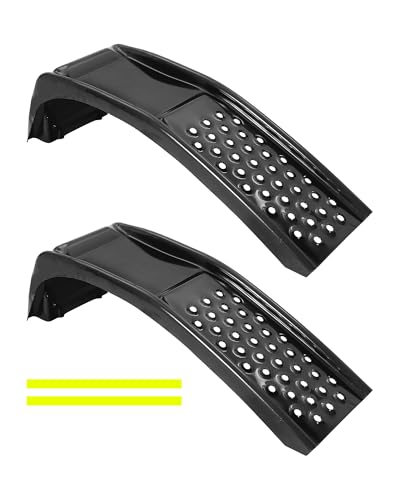
- 8-inch lift height
- Solid alloy steel construction
- 8,000-pound total capacity
Best For: Steel-ramp buyers seeking extra lift
Best for Easy Storage
MaxxHaul 50947 Stackable Car Ramps

- Stackable polypropylene design
- 6.7-inch lift and 6,500-pound pair capacity
- Built-in handles and ribbed platform
Best For: Compact garage storage and portability
Low-Profile Pick
Lightweight Car Ramps for Jack Support

- 2.44-inch lift with a 20-degree slope
- Honeycomb PP surface improves grip
- 6.8-pound pair is easy to transport
Best For: Low-chassis cars and portable home maintenance
High-Lift Workhorse
DNA Motoring 6.7-Inch Car Lift Ramps

- 6.69-inch lifting height for greater access
- 7.2-ton capacity per pair
- Non-slip base and portable handles
Best For: Garage repairs requiring more underbody clearance
Garage Maintenance Choice
Amazon Basics Low-Profile Car Ramps
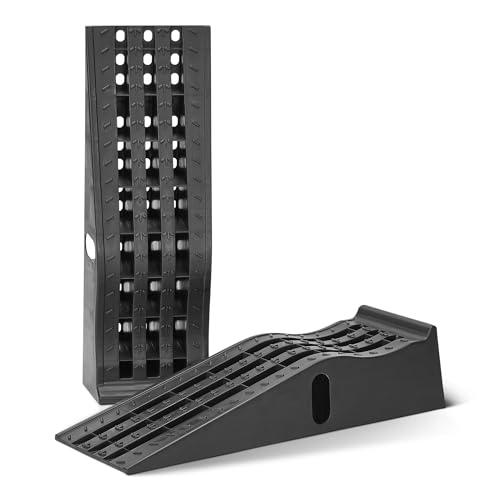
- 3,250-pound capacity per ramp
- Textured surface improves traction
- Designed for oil changes and home garages
Best For: Routine maintenance on solid, level garage floors
Best Heavy-Duty Pick

- Supports cars, trucks, and SUVs up to 16,000 pounds GVW
- Provides 6.7 inches of lift for routine maintenance
- Includes wheel chocks and a storage box
Best For: High-capacity home-garage maintenance
Best Simple Pick

- Designed for low-chassis cars, sports cars, and tuners
- Offers a 10-inch-wide tire platform
- Lightweight 5.3-pound-per-pair design
Best For: Low-clearance vehicle access
Best RV and Truck Pick

- Supports up to 20,000 pounds
- Provides 5.5 inches of clearance
- Built-in handles improve portability
Best For: Trucks, RVs, campers, and tandem-axle trailers
Best Overall Value – MaxxHaul 50515 6.25-Inch Lift Car Ramps
If you need dependable car ramps for routine repairs, the MaxxHaul 50515 combines a 6.25-inch lift with a sturdy, lightweight plastic build. Its ridged driving surface and rubber base stops are designed to help maintain traction and reduce movement during use.
Best For: Home mechanics performing oil changes, inspections, and general under-vehicle maintenance on compatible vehicles.
Pros:
- Supports up to 3,250 pounds per ramp and 6,500 pounds per pair.
- 6.25-inch lift provides additional underside access.
- Ridged surface and rubber stops help improve traction and stability.
- Plastic construction keeps the two-ramp set at 20.1 pounds.
Cons:
- Plastic construction may not suit shoppers specifically seeking steel ramps.
- The 6.25-inch lift is lower than some taller vehicle ramps.
- Warranty coverage is limited to 90 days.
With a practical lift height, traction-focused surface, and clearly stated 6,500-pound paired capacity, this MaxxHaul set is a balanced option for everyday garage maintenance.
Best High-Capacity Pick – Ironton Poly Car Ramp Set
Among these car ramps, the Ironton Poly Car Ramp Set stands out for its 12,000-pound gross vehicle weight capacity. High-impact poly construction, a non-skid tread pattern, and rubber feet provide a lightweight approach for cars, trucks, SUVs, and vans.
Best For: Owners of heavier vehicles, including full-size pickups, SUVs, vans, and 3/4-ton or 1-ton trucks.
Pros:
- Rated for 6,000 pounds per ramp and 12,000 pounds per pair.
- High-impact poly construction has a honeycomb internal structure.
- Non-skid tread pattern helps keep tires positioned on the ramp.
- Rubber feet help limit sliding during loading.
Cons:
- The 8.5-inch overall height may require checking vehicle approach clearance.
- Poly construction may not appeal to buyers who prefer solid steel.
- Its 20.6-pound pair is lightweight, but the set has no stated built-in handles.
The Ironton set is a strong choice when capacity is the priority. Its broad dimensions and 12,000-pound rating make it particularly useful for heavier vehicles, provided the vehicle and working surface are suitable.
Best Steel Option – Garvee 8-Inch Solid Steel Car Ramps
If you prefer steel car ramps, the Garvee 8 Inch Lift model uses solid alloy steel construction and provides an 8-inch lift. Its anti-slip structure and black coating are intended for stable, durable use during common vehicle service tasks.
Best For: DIY mechanics who want steel ramps for oil changes, tire rotations, inspections, and general maintenance.
Pros:
- Solid steel construction with a stated 8-inch lift height.
- Rated for 8,000 pounds total capacity.
- Anti-slip structure supports stability during service.
- Suitable for cars, trucks, and SUVs.
Cons:
- At 32.7 pounds, the pair is heavier than the plastic alternatives listed here.
- The supplied notes state 2,000 pounds per ramp, so users should account for that per-ramp rating.
- Steel construction may be less convenient to move and store than lighter poly designs.
The Garvee ramps trade some portability for a solid-steel design and an 8-inch lift. They make sense for shoppers who prioritize steel construction and want more working height for routine service.
Best for Easy Storage – MaxxHaul 50947 Stackable Car Ramps
MaxxHaul 50947 Lift Stackable Vehicle Car Ramp 6500 LBS Capacity Per Pair 3250 LBS Per Ramp 2 Pack
Check Price On AmazonThe MaxxHaul 50947 adds a practical storage advantage to the car ramps category with a stackable polypropylene design. It delivers a 6.7-inch lift, 6,500-pound capacity per pair, built-in side handles, and a ribbed platform for traction.
Best For: Garage owners and automotive enthusiasts who need ramps that are easier to carry, store, and transport.
Pros:
- Stackable design helps simplify storage and transportation.
- Built-in side handles improve portability.
- Supports 3,250 pounds per ramp and 6,500 pounds per pair.
- Ribbed platform surface helps increase traction.
Cons:
- The 6.7-inch lift is lower than the Garvee model’s 8-inch lift.
- Polypropylene construction may not be preferred over steel for some applications.
- Capacity is lower than the Ironton pair’s 12,000-pound rating.
For buyers with limited storage space, the stackable format and side handles are the defining advantages. Its capacity and lift are well suited to many routine maintenance jobs when matched to the vehicle’s requirements.
Low-Profile Pick – Lightweight Car Ramps for Jack Support
These car ramps are a practical choice for low-chassis cars, sports cars, and tuners that need modest lift without a steep approach. Their 20-degree slope raises vehicles 2.44 inches while leaving working space for a jack and other tools.
Best For: Low-profile vehicles, home repairs, and portable garage maintenance.
Pros:
- Low 2.44-inch lifting height suits low-chassis vehicles.
- Impact-resistant PP construction and a honeycomb surface provide grip and stability.
- Lightweight 6.8-pound pair is easy to carry and store.
- Curved design and drainage channels help keep the vehicle positioned securely.
Cons:
- The relatively low lift may not provide as much underbody access as taller ramps.
- Requires a flat, suitable work area and correct vehicle positioning.
Choose this pair when low approach height, portability, and jack access matter more than maximum elevation. The 6-ton stated capacity adds versatility, but buyers should still verify compatibility with their vehicle and maintenance task.
High-Lift Workhorse – DNA Motoring 6.7-Inch Car Lift Ramps
For drivers who want substantially more clearance, these car ramps provide a 6.69-inch lift and a 9.6-inch tire working width. The long, multifunctional design is intended for parking, low-profile vehicle repairs, and routine maintenance.
Best For: Higher-clearance automotive work, parking, and demanding garage maintenance.
Pros:
- 6.69-inch lifting height provides more working clearance than low-profile ramps.
- 7.2-ton pair capacity supports substantial vehicle loads when used correctly.
- Non-slip base and friction-grip surface support stable positioning.
- Hollow handles and a lightweight design make the ramps portable.
Cons:
- At 35.75 inches long and 9.61 kg per pair, these ramps require more storage space and handling than compact options.
- Must be placed on a flat surface and loaded centrally; overloading is specifically cautioned against.
This is the better fit when lift height is a priority and you have adequate storage and a level work area. Confirm the dimensions and your vehicle’s tire fit before purchasing.
Garage Maintenance Choice – Amazon Basics Low-Profile Car Ramps
These Amazon Basics car ramps are designed for oil changes, underbody access, and general maintenance on solid, level surfaces. Their 35.51-inch length and textured traction surface aim to provide a smooth approach and stable vehicle placement.
Best For: Home garages and routine automotive maintenance.
Pros:
- Rated for 3,250 pounds per ramp, or 6,500 pounds per pair.
- Reinforced plastic construction balances durability with manageable handling.
- Rubber base stops and anti-slip technology help prevent movement.
- Textured surface supports traction during vehicle positioning.
Cons:
- Designed for solid, level surfaces rather than uneven work areas.
- The listed capacity is a per-ramp limit, so buyers should account for vehicle weight and loading carefully.
For straightforward garage jobs, this pair offers a useful combination of rated capacity, traction features, and an approach designed for most vehicles. Check the vehicle’s weight and available floor space before use.
Best Heavy-Duty Pick – 16,000-LB Car Ramps
These heavy-duty car ramps are a practical choice when you need substantial capacity and useful clearance for routine vehicle maintenance. They support up to 16,000 pounds GVW, lift vehicles 6.7 inches, and include wheel chocks plus a storage box.
Best For: Cars, trucks, and SUVs needing oil changes, brake work, tire maintenance, or undercarriage inspections.
Pros:
- Supports up to 16,000 pounds GVW.
- Provides a 6.7-inch lift and 17-degree loading angle.
- Includes two wheel chocks and a multi-compartment storage box.
- Textured traction surface and stable base help reduce shifting.
Cons:
- Heavier than the compact alternative at 17.6 pounds.
- The six-month manufacturer warranty is relatively limited.
Choose these car ramps if capacity, clearance, and included organization accessories matter more than minimizing weight. Their polypropylene construction and stackable design suit repeated home-garage use.
Best Simple Pick – Compact 2.6-Inch Car Ramps
These low-profile car ramps are designed for vehicles with limited ground clearance. Their 2.6-inch lift, 10-inch width, and 17-degree slope provide a compact access solution for sports cars, tuners, and other low-chassis vehicles.
Best For: Low-clearance cars and garage work where portability and jack access are priorities.
Pros:
- Low 2.6-inch lift suits low-chassis vehicles.
- Wide 10-inch platform helps accommodate modified tires.
- Honeycomb traction design, curved sides, drainage, and bottom pads support stability.
- Weighs only 5.3 pounds per pair for easy carrying and storage.
Cons:
- The 2.6-inch lift may not provide enough clearance for every repair.
- Vehicle ground clearance and maintenance needs must be checked before use.
This is the most targeted option for low-profile vehicles, not a general-purpose high-clearance ramp. Verify compatibility before buying, especially if you need substantial room beneath the chassis.
Best RV and Truck Pick – 20,000-LB Service Ramps
These heavy-duty car ramps combine a 20,000-pound capacity with 5.5 inches of clearance, making them suitable for larger vehicles and tandem-wheel applications. Built-in handles also make this two-pack easier to move between jobs.
Best For: Trucks, SUVs, RVs, campers, and tandem-axle trailers needing routine service access.
Pros:
- Rated for up to 20,000 pounds.
- Provides 5.5 inches of undercarriage clearance.
- Concave, textured surfaces and serrated bottoms promote grip.
- Built-in handles make the ramps portable.
Cons:
- At 8.5 inches wide, the platform may be less suitable for unusually wide tires.
- The listed manufacturer warranty is only 90 days.
For larger vehicles, this model offers the strongest stated capacity in the roundup while retaining a manageable lift height. It is a sensible fit for owners who need portable ramps for recurring truck, RV, or trailer maintenance.
How We Picked These Car Ramps
We evaluated the selected Car Ramps against the factors that matter most during home vehicle maintenance: rated capacity, construction, lift height, ramp width, traction, portability, and storage. We also considered whether a design is better suited to cars, crossovers, trucks, RVs, or occasional garage use.
Capacity ratings should always be compared with your vehicle’s actual weight and the manufacturer’s instructions. A pair of ramps must support the loaded axle safely, not merely the vehicle’s curb weight in isolation. For any job requiring access beneath a vehicle, use wheel chocks, a level surface, and properly rated jack stands where appropriate.
Quick Comparison
| What to compare | Best for | What to watch |
|---|---|---|
| Low-profile plastic ramps | Cars with limited ground clearance and easy storage | Lower lift height and potentially narrower tire compatibility |
| Steel ramps | Heavy vehicles, frequent use, and demanding loads | Greater weight, bulk, and possible corrosion if poorly stored |
| Stackable ramps | Flexible storage and adjustable setup options | Confirm the manufacturer’s approved stacking configuration |
| High-capacity ramps | Trucks, SUVs, RVs, and commercial-style maintenance | Verify width, surface, and actual axle-load requirements |
Key Buying Factors for Car Ramps
Capacity and Vehicle Compatibility
Choose ramps rated above the heaviest axle load you expect, including passengers or cargo. Check the ramp width against your tires and confirm that the approach angle works with your vehicle’s clearance.
Lift Height and Access
A taller ramp can provide more working room, but it may require a longer approach and can be less convenient for low cars. Low-profile designs are easier to position but may offer limited underbody clearance.
Traction and Stability
Look for textured or deeply grooved surfaces, a broad base, and a design that resists sliding. Use ramps only on clean, dry, level pavement or concrete, and drive onto them slowly with the wheels centered.
Material, Portability, and Storage
Plastic ramps are typically lighter and easier to carry, while steel ramps may better suit frequent heavy-duty work. Consider handle openings, nesting or stacking features, corrosion resistance, and whether the pair fits your garage.
Who Should Buy Which Car Ramps?
For routine oil changes on a compact car or sedan, a low-profile pair with a secure traction surface is usually the easiest choice. SUV and pickup owners should prioritize width, approach angle, and a generous capacity rating. Frequent users or owners of heavier vehicles may prefer steel construction and a higher load rating, even if the ramps are harder to move.
If storage space is limited, choose a lightweight or stackable design. For occasional maintenance, focus on simple positioning and dependable stability rather than maximum lift height. Whichever model you select, inspect it before every use and replace it if you find cracks, bends, damaged traction surfaces, or other signs of wear.