Choosing a level 2 EV charger with energy monitoring is about more than speed. The best models help you charge efficiently, track usage, and manage costs from a home app or dashboard.
In this roundup, we focus on chargers that balance charging performance, smart features, safety certifications, and installation flexibility for different EV drivers and home setups.
Best 10 Level 2 Ev Charger with Energy Monitoring Picks for 2026
Smart Tesla Charging
EMPORIA NACS 48A Hardwired Charger

- Direct NACS/Tesla compatibility
- Real-time energy data via Wi‑Fi
- 48A hardwired, UL/ENERGY STAR certified
Best For: Tesla and NACS drivers who want smart energy monitoring
Feature-Rich Smart Charging

- Energy and cost tracking in the app
- Power sharing plus dynamic load balancing
- RFID, scheduling, and OTA support
Best For: Drivers who want flexible app controls and smart load management
Simple Smart Home Charging

- Real-time energy data and scheduling
- 48A hardwired J1772 charging
- UL listed and ENERGY STAR certified
Best For: J1772 drivers who want reliable smart monitoring
Load-Balancing Bundle
IYILO Charger with Energy Meter

- Meter and CT clamps included
- Dynamic load balancing out of the box
- App tracks energy, cost, and TOU rates
Best For: Homes that want built-in load balancing without a panel upgrade
Smart Plug-In Home Charger

- Tracks consumption and cost in the app
- Plug-in NEMA 14-50 design
- UL/ETL/FCC and Energy Star certified
Best For: Plug-in home charging with app-based energy monitoring
Trusted Hardwired Charger
ChargePoint HomeFlex Energy Star

- App control with charging data and reminders
- Adjustable 16A to 50A output
- Hardwired, indoor/outdoor rated
Best For: Permanent home installation with smart charging data
Editor’s Pick
40A WiFi Level 2 Charger with 25ft Cable
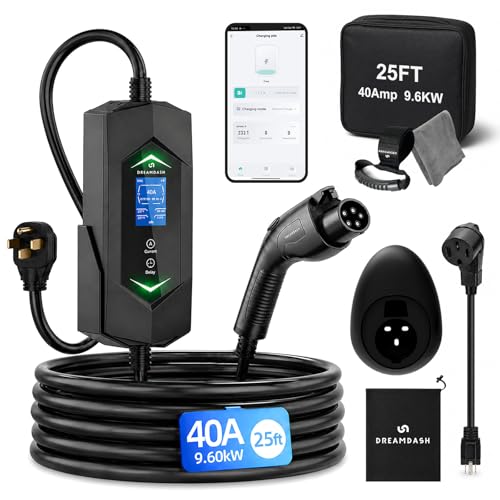
- Adjustable 6A-40A current via screen or app
- LCD shows charging speed, voltage, and delay time
- ETL/FCC/RoHS certified with IP66 weatherproofing
Best For: Drivers who want a portable 40A charger with app control and a long cable
Smart Monitoring Choice

- App tracks charging cost, history, status, and notifications
- Adjustable 16A-40A output with up to 9.6kW charging
- LED screen shows amperage, speed, voltage, and delay
Best For: EV owners who want app-based charging cost and history tracking
Smart Tesla Charging – EMPORIA NACS 48A Hardwired Charger
If you want a level 2 ev charger with energy monitoring for a Tesla or other NACS-equipped EV, this Emporia model keeps the setup simple by skipping the adapter. It is hardwired for up to 48A, supports real-time energy data over Wi‑Fi, and gives you scheduling tools to help manage charging around utility rates.
Best For: Tesla owners and NACS drivers who want a hardwired smart charger with app-based energy tracking.
Pros:
- NACS connector works directly with Tesla and other NACS vehicles.
- Wi‑Fi app access provides real-time energy data and charging schedules.
- 48A hardwired setup is rated for up to 46 miles of range per hour.
- UL listed and ENERGY STAR certified for added confidence.
Cons:
- Hardwired installation is recommended, so it is not a simple plug-in option.
- Professional installation may add cost and planning.
This is a strong fit if you want Tesla-native compatibility plus smart monitoring in one home charger. It focuses on straightforward charging, certification, and app visibility rather than extra hardware add-ons.
Feature-Rich Smart Charging – IYILO 48A J1772 Charger
This level 2 ev charger with energy monitoring is built for drivers who want detailed control over charging, from scheduling and RFID access to app-based energy and cost tracking. With adjustable current, power sharing, and dynamic load balancing support, it is designed to fit more advanced home charging setups.
Best For: EV owners who want a smart J1772 charger with flexible controls and utility-aware charging features.
Pros:
- Tracks energy usage and cost in the app.
- Supports scheduled charging, RFID, and OTA updates.
- Power sharing and dynamic load balancing help manage home electrical limits.
- ETL and Energy Star certified with a 25ft cable.
Cons:
- Dynamic load balancing requires the Energy Meter bundle for full use.
- 5GHz Wi‑Fi is not supported.
- Tesla drivers need a separate NACS adapter.
Overall, this IYILO charger stands out if you want more than basic charging control. Its app tools and power management features make it well suited to households trying to monitor usage and avoid overloads.
Simple Smart Home Charging – EMPORIA J1772 48A Charger
If you need a level 2 ev charger with energy monitoring for a standard J1772 vehicle, this Emporia unit keeps the feature set focused and practical. It offers hardwired 48A charging, Wi‑Fi app access for real-time energy data, and scheduling tools without extra complexity.
Best For: J1772 EV drivers who want a dependable smart charger with energy monitoring and a straightforward setup.
Pros:
- Wi‑Fi connectivity provides real-time energy data in the app.
- 48A hardwired charging can deliver up to 46 miles of range per hour.
- UL listed and ENERGY STAR certified.
- Compatible with a wide range of North American J1772 EVs.
Cons:
- Does not support NACS/Tesla without a separate charger or search for a different model.
- Hardwired install is recommended rather than plug-in convenience.
This Emporia model is a practical choice if you want core smart-charging features and reliable energy visibility. It is especially appealing for households that already use a J1772 port and want a clean, certified home setup.
Load-Balancing Bundle – IYILO Charger with Energy Meter
This level 2 ev charger with energy monitoring is aimed at owners who want load balancing included from the start. The bundled energy meter and CT clamps enable dynamic load balancing right out of the box, while the app adds scheduling, RFID access, and energy/cost tracking for a more complete home charging package.
Best For: EV owners who want an all-in-one charger and meter bundle for real-time load balancing.
Pros:
- Energy meter and CT clamps are included for dynamic load balancing.
- App tracks energy usage, cost, and TOU rates.
- Supports scheduled charging, RFID, and OTA upgrades.
- ETL and Energy Star certified with a NEMA 4 waterproof rating.
Cons:
- Hardwired installation is required.
- 5GHz Wi‑Fi is not supported.
- Tesla owners need a J1772 adapter, which is not included.
If panel capacity is a concern, this bundle is the most complete option in the group. Including the meter upfront helps simplify load management and makes the charging setup more ready for real-world home power limits.
Smart Plug-In Home Charger – EVIQO 40A WiFi Level 2
If you want a level 2 ev charger with energy monitoring for a plug-in setup, the EVIQO is built around app-based control and overnight home charging. It delivers up to 40A on a dedicated 50A/240V circuit, and the smartphone app can start or stop charging, set current from 6A to 40A, and track consumption and cost.
Best For: Drivers who want a plug-in J1772 charger with app-based energy tracking and weatherproof indoor/outdoor use.
Pros:
- Smart app tracks consumption and cost, with current control from 6A to 40A
- UL, ETL, FCC, and Energy Star certified
- IP66/NEMA 4 weatherproof enclosure for indoor or outdoor installation
- 25-foot cable and NEMA 14-50 plug-in design
Cons:
- Requires a dedicated 50A / 240V circuit and a NEMA 14-50 outlet
- Smart features need 2.4 GHz WiFi
- Designed for non-Tesla EVs unless used with a J1772-to-NACS adapter, which is not included
This is a practical pick if you want simple plug-in installation and useful monitoring without hardwiring. The app-driven energy and cost tracking makes it easier to keep tabs on charging use at home.
Trusted Hardwired Charger – ChargePoint HomeFlex Energy Star
The ChargePoint HomeFlex is a level 2 ev charger with energy monitoring features through the ChargePoint Mobile App, making it a strong fit for drivers who want charging data and reminders at home. It is hardwired, adjustable from 16A to 50A, and rated for indoor or outdoor installation by an electrician.
Best For: Homeowners who want a hardwired smart charger from a well-known charging network brand.
Pros:
- App control with reminders, charging info, and smart home connectivity
- Adjustable 16A to 50A output
- Energy Star and UL certified for safe home charging
- 23-foot cable and indoor/outdoor rating
Cons:
- Hardwired installation requires an electrician
- Some app functions need WiFi
- Energy monitoring is app-based rather than a dedicated display
For shoppers who value reliability and app-based charging data, the HomeFlex is a straightforward option. Its flexible amperage and hardwired design make it best suited to permanent home installations.
Flexible High-Power Charger – RIPPLEON 48A Smart Level 2
RIPPLEON’s level 2 ev charger with energy monitoring is aimed at buyers who want flexible installation and real-time tracking in one unit. It supports plug-in use up to 40A on a NEMA 14-50 outlet, or hardwired installation up to 48A, while the smart app can manage real-time energy or cost and schedule off-peak charging.
Best For: EV owners who want a high-output charger with both plug-in and hardwired options.
Pros:
- Smart app shows real-time energy or cost and supports scheduling
- Dual installation options: plug-in or hardwired
- Up to 48A / 11.5kW hardwired output
- UL, ETL, FCC certified and IP65 rated
Cons:
- Hardwired setup recommends a professional electrician
- Plug-in mode is limited to 40A / 9.6kW
- Wi-Fi and app features are required for the monitoring functions
This model stands out if you want one charger that can grow with your setup. The combination of higher hardwired power and app-based energy tracking gives it a lot of flexibility for home charging.
Editor’s Pick – 40A WiFi Level 2 Charger with 25ft Cable
If you want a level 2 ev charger with energy monitoring-style visibility, this DREAMDASH unit focuses on the practical controls that matter most: adjustable current, real-time LCD readouts, and app-based charging management. It supports up to 40A at 9.6kW, making it a strong fit for home users who want faster charging and simple monitoring through the screen or app.
Best For: Drivers who want a portable 40A charger with app control, adjustable output, and a long cable for home use.
Pros:
- Adjustable current from 6A to 40A through the LCD screen or app
- LCD displays charging speed, input voltage, current intensity, and delay time
- ETL, FCC, and RoHS certified with overvoltage, overheating, and short-circuit protection
- 25ft military-grade cable and IP66-rated weatherproof enclosure
Cons:
- Requires a 240V NEMA 14-50 socket for proper use
- App setup depends on 2.4GHz Wi-Fi and may need factory reset steps
- Not a fit for users who need built-in billing-style energy reporting
This is a feature-rich portable charger for buyers who want high output plus visible charging data on screen and in the app. It emphasizes control, safety, and durability more than advanced utility-style energy monitoring.
Smart Monitoring Choice – 40A App-Control EV Charger
This AIMILER level 2 ev charger with energy monitoring is built around app visibility and screen-based charging data, so you can check charging cost, history, status, and full-charge notifications. With up to 40A output and a 25ft cable, it suits buyers who want a smart home charging setup with useful day-to-day tracking.
Best For: EV owners who want app-based charging cost and history tracking plus a high-output portable charger.
Pros:
- Smart WiFi app shows charging cost, history, status, and full-charge notifications
- Adjustable amperage from 16A to 40A with up to 9.6kW output
- LED screen displays amperage, charging speed, input voltage, and delay time
- ETL/FCC listed with multiple safety standards and a 25ft military-grade cable
Cons:
- Needs a 240V NEMA 14-50 outlet for the intended setup
- First app connection requires 2.4GHz Wi-Fi
- Not compatible with Tesla/NACS cars without an adapter
Among portable chargers in this class, this one stands out for giving you more charging visibility through the app, not just basic plug-and-charge operation. It is a solid pick if monitoring, scheduling, and cost tracking are part of your buying criteria.
Budget Smart Pick – 32A WiFi Portable EV Charger
If you want a level 2 ev charger with energy monitoring features but do not need the highest-output option, this AIMILER 32A model keeps the smart app tools and charging readouts while stepping down the max current. It offers app-based charging period control, cost and history tracking, and an LED screen that shows the key charging data you’d actually use at home.
Best For: Home EV drivers who want smart app tracking and a more affordable 32A portable charger.
Pros:
- Smart WiFi app can track charging cost, history, and full-charge notifications
- Adjustable amperage from 16A to 32A with up to 7.68kWh output
- LED screen shows amperage, charging speed, input voltage, and delay time
- ETL/FCC listed with a 25ft military-grade cable and IP66-style protection
Cons:
- Lower max output than 40A alternatives
- Requires a 240V NEMA 14-50 outlet for normal use
- First app setup depends on 2.4GHz Wi-Fi
This version makes sense if you want smart charging data and scheduling without paying for the higher-amperage model. It still gives you practical monitoring and control, just with a lower ceiling on charging speed.
How We Picked the Best Level 2 Ev Charger with Energy Monitoring
We prioritized chargers with practical home-use benefits: verified safety listings, useful charging speeds, energy monitoring or app-based usage tracking, reliable build quality, and installation options that match common electrical setups. We also favored models with clear compatibility for North American EVs and Tesla/NACS or J1772 support where relevant.
Quick Comparison
For most drivers, the main tradeoff is between maximum amperage, installation style, and smart features. Hardwired models often support higher output and a cleaner installation, while plug-in versions are easier to move or replace. If you want detailed charging data, look for app reporting, consumption history, or built-in meter functions rather than basic Wi-Fi alone.
Key Buying Factors for a Level 2 Ev Charger with Energy Monitoring
Charging Speed and Amperage
A 32A charger is enough for many households, while 40A and 48A models can cut charging time when your panel and wiring support them. Check your vehicle’s onboard charger limits too, since the car ultimately determines the maximum rate it can accept.
Energy Monitoring Quality
Not all monitoring is equal. Some chargers show simple session totals, while others provide historical usage, cost estimates, and scheduling insights. If you want to track charging expenses accurately, look for a charger with clear app reporting or a built-in meter.
Installation Type
Hardwired chargers are often preferred for higher power and a more permanent setup. Plug-in units using a NEMA 14-50 outlet can be easier to install and relocate, but they may be limited by circuit design and outlet quality.
Connector Compatibility
Make sure you need J1772 or NACS/Tesla compatibility before buying. Some chargers include adapters or come preconfigured for Tesla use, while others are designed mainly for non-Tesla EVs.
Smart Features and Connectivity
Wi-Fi app control can add scheduling, remote start/stop, and load insights. For a Level 2 Ev Charger with Energy Monitoring, reliable app stability matters more than a long list of extra features.
Who Should Buy Which Level 2 Ev Charger with Energy Monitoring?
Choose a 48A hardwired charger if you want maximum home charging performance and your electrical service can support it. Choose a 40A plug-in charger if you want a simpler install with strong everyday charging speed. Choose a smart app-first model if your priority is usage tracking, scheduling, and energy visibility. Choose a budget-friendly 32A option if you mostly charge overnight and want solid basics without paying for peak output you may not need.
The best choice depends on your vehicle, panel capacity, and how much value you place on monitoring versus raw speed.