Winter puts extra demands on a solar charging system. Shorter days, low temperatures, snow cover, and battery-specific charging requirements can make controller selection especially important.
This roundup compares 10 options across MPPT and PWM designs, from compact 12V systems to higher-capacity installations. Use the guide below to narrow your choice by system size, battery type, weather exposure, and monitoring needs.
Best 10 Solar Charge Controllers for Winter Use Picks for 2026
Top Winter Performance
Victron SmartSolar MPPT 100/50

- 50A MPPT capacity for larger systems
- Bluetooth monitoring and configuration
- Useful load-disconnect control
Best For: Higher-output 12V or 24V systems
Best Budget 12V Convenience
12V 20A PWM Controller with LCD
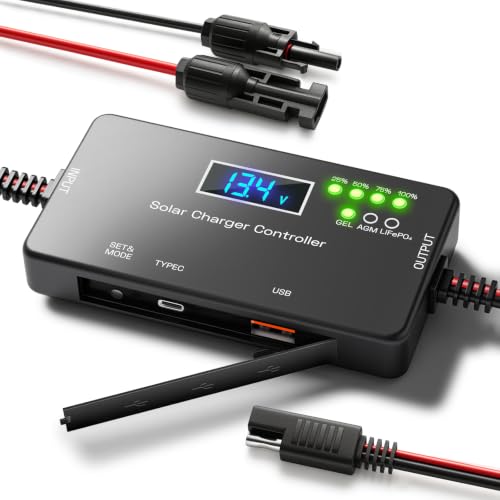
- LCD shows voltage and charge level
- USB-C and USB fast charging ports
- Six listed safety protections
Best For: Simple 12V RV, boat, or shed systems
Best Compact MPPT

- Efficient MPPT tracking for variable light
- Works with 12V and 24V systems
- Compact Bluetooth-enabled design
Best For: Smaller systems needing smart MPPT control
Best Weather-Ready Compact Pick

- IP67 waterproof compact housing
- 10A MPPT charging for 12V systems
- Simple SAE plug-and-play connection
Best For: Small exposed or portable 12V setups
High-Capacity Pick

- 12V–96V auto-sensing compatibility
- Up to 98% MPPT conversion efficiency
- LCD monitoring and multi-battery support
Best For: Large RV and off-grid solar systems
Compact RV Choice
Renogy Wanderer 10A PWM Controller
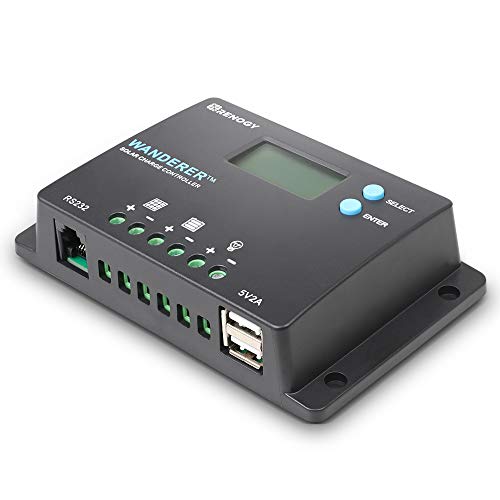
- 12V/24V compatibility
- Four-stage charging with temperature compensation
- Compact LCD-equipped design
Best For: Small RV, marine, and cabin systems
Weatherproof 12V Pick

- IP68 waterproof outdoor housing
- MPPT support for 20W–200W panels
- LCD, USB, and Type-C charging
Best For: Small outdoor 12V solar systems
Best Smart PWM Pick
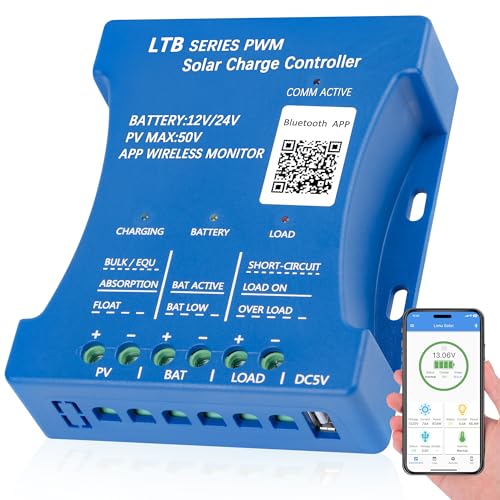
- Bluetooth app for monitoring and setup
- Supports five battery categories
- Seven programmable load modes
Best For: Connected 12V/24V RV and off-grid systems
Best Efficiency Choice

- Up to 99% MPPT tracking efficiency
- Bluetooth and LCD monitoring
- Works with LiFePO4 and lead-acid batteries
Best For: Efficiency-focused 12V/24V solar systems
Best Compact Outdoor Pick
SOLPERK 10A Waterproof PWM Controller

- IP67 waterproof outdoor housing
- Automatic 12V/24V identification
- Compact SAE plug-and-play installation
Best For: Small AGM, gel, or flooded-battery systems
Top Winter Performance – Victron SmartSolar MPPT 100/50
For solar charge controllers for winter use, the Victron SmartSolar MPPT 100/50 is a strong choice when changing light conditions and system monitoring matter. Its MPPT tracking is designed to maximize available solar input, including when panels are partly shaded, while Bluetooth connectivity provides configuration and performance history through the VictronConnect app.
Best For: Larger 12V or 24V systems needing high charging capacity, app monitoring, and configurable load control.
Pros:
- 50A MPPT charging capacity for higher-output systems
- MPPT tracking helps capture available power in partial shade
- Bluetooth app supports monitoring, settings, firmware updates, and alarms
- Load output can disconnect devices when battery voltage is too low
Cons:
- No built-in display; monitoring relies on connected devices
- Its 100V, 50A capacity may be more than a small winter setup needs
This is the most capable option here for a larger installation where winter daylight, shading, and battery protection require fine control. Confirm panel voltage, battery voltage, and current requirements before buying.
Best Budget 12V Convenience – 12V 20A PWM Controller with LCD
This 12V PWM controller is a practical pick among solar charge controllers for winter use when you want straightforward battery-status checks and convenient device charging. Its LCD shows battery voltage and charge level, while built-in protections and zero-night-drain operation help simplify seasonal RV, boat, shed, and outdoor setups.
Best For: Small 12V systems using LiFePO4, AGM, or Gel batteries and needing an LCD plus USB charging ports.
Pros:
- Supports 12V batteries and panels up to 300W
- LCD provides voltage and 25%/50%/75%/100% charge indications
- Includes 22W USB-C PD and 18W USB QC3.0 charging
- Six listed protections include overcharge, short-circuit, and over-temperature protection
Cons:
- Designed only for 12V systems, not 24V or 36V batteries
- PWM charging is less power-optimizing than MPPT designs
- Plastic construction and basic LCD may suit utility use better than advanced monitoring
Choose this model for a simple 12V winter installation where visibility and direct USB charging are more important than maximum energy harvesting. Follow the stated connection order: battery first, then solar panel.
Best Compact MPPT – Victron SmartSolar MPPT 75/15
The Victron SmartSolar MPPT 75/15 is a compact option for solar charge controllers for winter use, especially when limited sunlight and partial shade make efficient tracking valuable. It supports 12V and 24V systems, adds Bluetooth access through VictronConnect, and can coordinate with other SmartSolar controllers in a larger installation.
Best For: Small to mid-size 12V or 24V systems that need MPPT efficiency and app-based monitoring in a compact enclosure.
Pros:
- MPPT tracking is designed to maximize available panel output
- Supports both 12V and 24V battery systems
- Bluetooth enables configuration, alarms, firmware updates, and history
- Compact 4.7-by-2.1-by-1.8-inch design suits space-constrained installations
Cons:
- 15A capacity is not intended for high-power solar arrays
- 75V panel-input rating requires careful panel configuration
- No full built-in display for on-device status checks
This is a well-balanced choice when winter performance and smart monitoring are priorities but installation space or array size is limited. Match the controller to your panel voltage and expected charging current.
Best Weather-Ready Compact Pick – SOLPERK 10A 12V MPPT
For compact solar charge controllers for winter use, the SOLPERK 10A 12V MPPT controller emphasizes simple installation and outdoor-friendly construction. It is designed for 12V batteries, uses LED indicators for basic status checks, and lists IP67 waterproofing plus protections against under-voltage, over-voltage, overload, short circuits, and reverse connection.
Best For: Small 12V outdoor, automotive, or portable battery setups using compatible lead-acid or LiFePO4 batteries.
Pros:
- MPPT design is advertised as more efficient than PWM controllers
- IP67 waterproof construction suits exposed installations
- Compatible with AGM, lead-acid, Gel, deep-cycle, sealed, flooded, and LiFePO4 batteries
- SAE port supports simple plug-and-play installation
Cons:
- Limited to 12V systems and 10A charging
- LED indicators provide less detail than an LCD or app
- Verify battery compatibility and charging settings for your specific chemistry
This controller makes the most sense for a modest 12V winter setup where compact size, waterproofing, and easy connections outweigh advanced data logging. Its low current rating is best matched with smaller panels and batteries.
High-Capacity Pick – POWLAND 120A MPPT Controller
For larger off-grid systems, the POWLAND 120A is one of the more versatile solar charge controllers for winter use. Its MPPT design is intended to maximize harvesting when sunlight is limited, while automatic support for 12V through 96V battery systems gives it broad installation flexibility.
Best For: High-capacity RV systems, off-grid homes, and setups using multiple battery voltages.
Pros:
- Supports 12V, 24V, 36V, 48V, 60V, 72V, 84V, and 96V systems with automatic voltage detection.
- MPPT technology is rated for up to 98% conversion efficiency.
- Supports LiFePO4, AGM, GEL, and flooded lead-acid batteries.
- LCD shows PV input, charging stage, and system warnings.
Cons:
- The 120A capacity may be excessive for small solar arrays.
- The notes do not specify an outdoor waterproof rating.
This controller stands out when winter conditions and larger battery banks make efficient energy collection and broad voltage compatibility priorities. Confirm the system’s current requirements and installation conditions before choosing it.
Compact RV Choice – Renogy Wanderer 10A PWM Controller
The Renogy Wanderer 10A is a compact option for smaller 12V or 24V installations. For solar charge controllers for winter use, its four-stage charging, temperature compensation, and low self-consumption can help support dependable battery maintenance when available sunlight is reduced.
Best For: Small RV, marine, cabin, and DIY solar systems with modest charging demands.
Pros:
- Compatible with 12V and 24V battery systems.
- Four-stage charging supports AGM, Gel, Flooded, and manually configured lithium batteries.
- Includes temperature compensation and protections against overcharge, overload, short circuit, and reverse polarity.
- Compact design, LCD display, and optional Bluetooth monitoring support.
Cons:
- Its 10A PWM capacity is intended for smaller systems.
- IP32 protection is less suited to direct exposure than a higher-rated waterproof enclosure.
The Wanderer is a practical budget-conscious choice when system size is limited and compact installation matters. Its PWM design is less energy-focused than MPPT, but the charging stages and safety features add useful control for basic winter setups.
Weatherproof 12V Pick – SUNAPEX 15A MPPT Controller
The SUNAPEX 15A combines MPPT charging with an IP68 waterproof housing, making it a strong candidate among solar charge controllers for winter use outdoors. It is designed for 12V battery systems and solar panels from 20W to 200W, with monitoring and charging ports built into the controller.
Best For: Outdoor 12V systems on RVs, boats, trailers, cabins, sheds, and gates.
Pros:
- MPPT charging is designed to improve energy capture in changing sunlight.
- IP68 housing helps protect against rain, dust, and moisture.
- Supports LiFePO4, AGM, Gel, Flooded, and Sealed Lead-Acid batteries.
- LCD monitoring plus USB and Type-C charging ports add everyday convenience.
Cons:
- Compatible only with 12V battery systems.
- 15A capacity and 200W panel guidance limit it to smaller installations.
For a compact outdoor setup, the SUNAPEX offers a useful balance of weather protection, MPPT charging, and clear status monitoring. It is best suited to modest 12V arrays rather than larger multi-voltage systems.
Best Smart PWM Pick – 30A Bluetooth PWM Controller
For solar charge controllers for winter use, this 30A PWM model stands out when you want convenient monitoring and flexible load scheduling. Its Bluetooth app provides access to charging status, battery settings, load modes, and device information, while the controller supports 12V and 24V systems.
Best For: RV, boat, and off-grid users who want app-based monitoring, multiple battery-type options, and programmable load control.
Pros:
- Bluetooth app enables remote monitoring and configuration.
- Supports sealed, gel, flooded, LiFePO4, and lithium batteries.
- Offers seven load modes, including dusk-to-dawn and timer settings.
- Includes overcurrent, short-circuit, overheating, reverse-connection, and other protections.
Cons:
- It uses PWM charging rather than more efficient MPPT technology.
- Automatic 12V/24V detection requires sufficient initial battery voltage and applies automatically to non-lithium batteries.
- The app and configuration features may be more involved than a basic controller requires.
This is a feature-rich choice for winter setups where remote status checks and scheduled loads are useful. Choose it when connectivity and compatibility matter more than the efficiency advantages of MPPT.
Best Efficiency Choice – LiTime 30A MPPT Controller
Among solar charge controllers for winter use, the LiTime 30A MPPT model is a strong option when extracting more available power from a solar array is a priority. It continuously tracks the array’s maximum power point, supports 12V and 24V systems, and combines Bluetooth access with an LCD display.
Best For: LiFePO4 or lead-acid battery systems needing efficient charging, local readouts, and remote system information.
Pros:
- MPPT tracking efficiency is rated at least 99%, with peak conversion efficiency up to 98%.
- Built-in Bluetooth and LCD controls provide local and remote monitoring.
- Compatible with LiFePO4 and adjustable for sealed, gel, and other lead-acid batteries.
- Die-cast aluminum construction supports heat dissipation, and multiple protections are included.
Cons:
- Its 30A rating limits system size to the listed 450W at 12V or 900W at 24V PV input.
- It is larger and heavier than compact basic controllers, weighing 4.4 pounds.
- It is not described as waterproof, so installation should account for environmental exposure.
The LiTime is the most efficiency-focused option in this group. Its MPPT design, display, Bluetooth, and battery flexibility make it especially compelling for winter installations where limited sunlight makes solar harvesting important.
Best Compact Outdoor Pick – SOLPERK 10A Waterproof PWM Controller
For smaller solar charge controllers for winter use, the SOLPERK 10A model offers a compact, weather-resistant design for basic 12V or 24V battery systems. Its IP67 waterproof rating, LED indicators, and plug-and-play SAE connection make it practical for outdoor installations with modest power needs.
Best For: Small RV, boat, and car solar setups using AGM, gel, or flooded deep-cycle batteries.
Pros:
- IP67 waterproof construction suits outdoor use.
- Automatically identifies 12V or 24V systems and supports up to 150W at 12V or 300W at 24V.
- Three-stage PWM charging and multiple protections help manage routine battery charging.
- Compact design, SAE port, pre-drilled mounting holes, and included manual simplify installation.
Cons:
- The 10A maximum current is unsuitable for larger solar arrays.
- LED indicators provide less detailed information than an LCD or app.
- Compatibility is listed for AGM, gel, and flooded batteries rather than lithium types.
This is a straightforward choice for compact outdoor systems where waterproofing and easy installation matter more than advanced monitoring. Its limited 10A capacity makes careful panel and battery sizing essential.
How We Picked the Best Solar Charge Controllers for Winter Use
We focused on controller type, rated current, supported system voltage, battery compatibility, weather resistance, and monitoring features. MPPT models generally make better use of limited winter sunlight and can be advantageous when panel voltage differs substantially from battery voltage. PWM controllers remain practical for smaller, budget-focused systems using well-matched panels.
We also considered cold-weather installation needs, including waterproofing, wiring flexibility, automatic voltage detection, Bluetooth or LCD monitoring, and support for lithium, AGM, gel, or flooded batteries. Always verify the manufacturer’s charging specifications before connecting a battery.
Quick Comparison
| System need | Best controller type | What to prioritize |
|---|---|---|
| Small RV, boat, or backup battery | 10A–15A PWM or MPPT | Simple setup, low standby draw, weather protection |
| 12V or 24V medium system | 20A–30A MPPT | Battery profiles, adequate PV input, monitoring |
| Larger off-grid array | 50A or higher MPPT | Output headroom, high PV voltage rating, reliable heat management |
| Mixed or expanding systems | Automatic-voltage MPPT | Configuration flexibility and clear limits |
Key Buying Factors for Solar Charge Controllers for Winter Use
MPPT Versus PWM
MPPT controllers can convert excess panel voltage into useful charging current, which is helpful during weak winter sun or when panels operate at higher voltages. PWM units are simpler and often less expensive, but they work best when panel and battery voltage are closely matched.
Cold-Weather Voltage and PV Limits
Solar-panel voltage can rise as temperatures fall. Check the controller’s maximum PV open-circuit voltage, then leave a safety margin based on the lowest expected temperature and the number of panels connected in series. Exceeding that limit can damage the controller.
Battery Chemistry and Charging Profiles
Choose a model with a compatible profile for your battery. Lithium batteries may require low-temperature charging protection or a battery-management system that prevents charging below the permitted temperature. AGM, gel, and flooded batteries use different absorption and float settings, so adjustable or clearly specified profiles are valuable.
Capacity, Wiring, and Protection
Match the controller’s rated charging current to the array’s expected output, with reasonable headroom for bright winter conditions. Confirm wire-gauge requirements, fuse placement, reverse-polarity protection, overtemperature safeguards, and whether the enclosure is suitable for snow, condensation, or splash exposure.
Who Should Buy Which Solar Charge Controllers for Winter Use?
Choose a compact PWM controller for a small, straightforward 12V setup where cost and simplicity matter most. A small MPPT model is a better fit when winter performance, higher-voltage panels, or variable sunlight justify the added cost. For medium systems, 20A–30A MPPT controllers offer a useful balance of efficiency, monitoring, and expansion room.
For larger battery banks or multiple panels, select a higher-current MPPT controller only after confirming its PV voltage, current, and system-voltage limits. Buyers who check performance remotely should prioritize Bluetooth-enabled models, while those who prefer at-a-glance status information may want a built-in LCD. Regardless of the model, install the controller in a dry, ventilated location and follow the correct battery-first connection sequence.