An automotive head up display with tire pressure monitor can reduce distraction by putting the information you need right in your line of sight. It is a smart upgrade for drivers who want speed, warnings, and tire status without constant dashboard checks.
In this roundup, we focus on practical options for daily commuting, long trips, and vehicle-specific fitment, so you can choose a setup that matches your car, your driving habits, and your budget.
Best 10 Automotive Head Up Display with Tire Pressure Monitor Picks for 2026
Factory-Style HUD

- Factory-style HUD for 2010-2018 Toyota 4Runner
- Shows speed, RPM, coolant temp, battery voltage, and alerts
- Plug-and-play OBD install with no cutting
Best For: 4Runner drivers wanting an OEM-look HUD with broad vehicle readouts
Solar TPMS
Real-Time 4-Sensor Tire Monitor

- Tracks pressure and temperature for all 4 tires
- Solar charge plus USB backup power
- Five alarm modes with external IPX67 sensors
Best For: Drivers who want a solar-powered TPMS with strong alert coverage
Charger-Powered TPMS
Adjustable Car Voltage Monitor
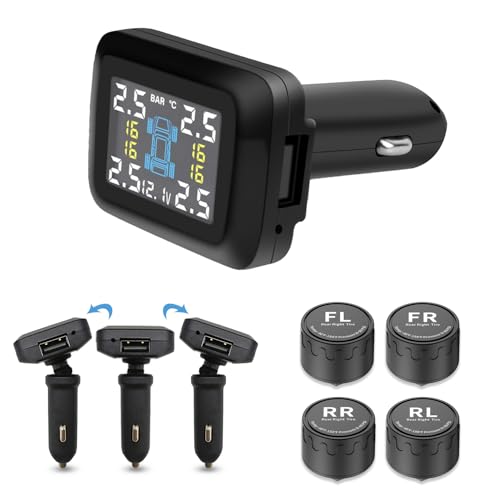
- Real-time tire pressure, temperature, and voltage
- Powered by cigarette lighter with no built-in battery
- Six alarm types with adjustable display angle
Best For: Drivers who want a powered TPMS with voltage readout and flexible mounting
Pressure Guard

- Dedicated 4-sensor tire pressure monitor
- Auto-calibrates and alarms off your set pressure
- Solar charging with auto wake/sleep
Best For: RV, trailer, SUV, sedan, and truck owners
Road Vision Duo
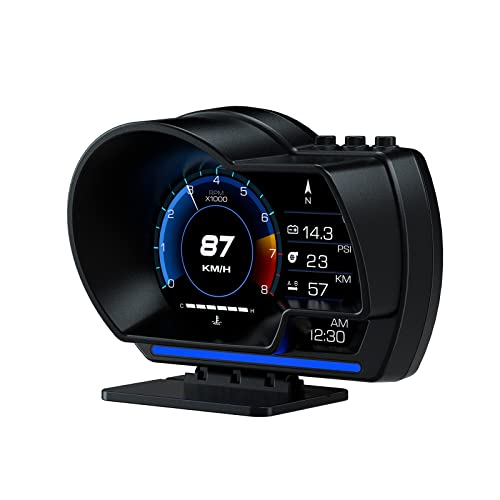
- Dual OBD+GPS HUD with speed and RPM
- Shows water temperature and overspeed alerts
- Dashboard or windshield mounting options
Best For: Drivers who want a simple dual-mode HUD
Flexible A-Pillar Pick
Car HUD P8 Dual-System Display

- A-pillar or dashboard mounting options
- OBDII + GPS dual-system support
- Displays speed, RPM, voltage, water temp
Best For: Drivers who want flexible mounting and a simple dual-system HUD
Diagnostic and Alert Pick
MH OBD2+GPS HUD with Fault Scan

- Shows speed, turbo pressure, voltage, and more
- Scans and clears fault codes
- Custom alarms for speed, temp, voltage, and RPM
Best For: Drivers who want diagnostics and customizable warnings in a compatible OBD2 car
Broad-Compatibility Backup

- GPS mode works with all vehicles
- Adaptive sensor helps cut ghosting
- Easy plug-and-play installation
Best For: Drivers who want a simple HUD with universal GPS compatibility
Factory-Style HUD – Toyota 4Runner OEM+ Display
If you want an automotive head up display with tire pressure monitor-style convenience for a Toyota 4Runner, this OEM-style unit keeps key driving data in your line of sight without looking down. It’s designed as a factory-style upgrade for 2010-2018 4Runners and plugs into the OBD port for a clean install.
Best For: 4Runner owners who want an OEM-look HUD with broader vehicle data and easy plug-and-play installation.
Pros:
- Projects speed, RPM, coolant temperature, battery voltage, door status, and engine alerts.
- Plug-and-play OBD connection with no wire cutting or permanent modifications.
- Factory-style design blends into the interior for a more OEM appearance.
- Useful for daily driving, road trips, and off-road use.
Cons:
- Turn signal indicator display is not available on TRD models.
- Compatibility is limited to Toyota 4Runner 2010-2018.
This is a strong pick if you want a dashboard-style upgrade that feels integrated rather than aftermarket. It focuses on driver visibility and convenience, with support for several important vehicle alerts.
Solar TPMS – Real-Time 4-Sensor Tire Monitor
This automotive head up display with tire pressure monitor category pick is for drivers who mainly want live tire data in an easy-to-read screen. It monitors pressure and temperature for all four tires, with solar charging, USB backup charging, and multiple alarms for safer everyday driving.
Best For: Cars without built-in TPMS, or drivers who want a solar-powered monitor with external sensors and frequent alerts.
Pros:
- Real-time pressure and temperature monitoring for all 4 tires on one screen.
- 5 alarm modes include high/low pressure, high temperature, fast/slow leak, low sensor battery, and sensor fault.
- Solar charging with USB charging backup for flexible power.
- External sensors are IPX67-rated and install quickly without tire disassembly.
Cons:
- Uses external valve sensors, which may not suit every driver’s preference.
- The product notes show a long feature list, so setup and customization may take some time.
If tire safety is your priority, this TPMS is loaded with monitoring and warning features. It’s a practical choice for drivers who want constant tire visibility without wiring into the vehicle.
Universal Speed HUD – Day/Night Digital Speedometer
For shoppers comparing an automotive head up display with tire pressure monitor options, this universal HUD is the simpler speed-focused choice. It projects speed onto the windshield, uses GPS and BeiDou positioning for fast readings, and automatically adjusts brightness for day and night use.
Best For: Drivers who want a compact, universal HUD for speed display only.
Pros:
- Projects speed onto the windshield to reduce the need to look down.
- Dual GPS and BeiDou chips provide real-time speed information.
- Automatic brightness adjustment supports daylight and nighttime visibility.
- Compact plug-and-play design powers from a 5V USB connection.
Cons:
- Does not include tire pressure monitoring.
- Focuses on speed display rather than broader vehicle data.
This is the right pick if you want a basic, easy-to-use HUD with no complicated installation. It keeps the feature set focused on speed, visibility, and convenience.
Charger-Powered TPMS – Adjustable Car Voltage Monitor
If you’re shopping for an automotive head up display with tire pressure monitor functionality, this TPMS stands out for its car-charger power and adjustable viewing angle. It shows real-time tire pressure and temperature, adds vehicle voltage monitoring, and uses wireless sensors for a straightforward install.
Best For: Drivers who want a charger-powered TPMS with voltage monitoring and adjustable screen positioning.
Pros:
- Displays tire pressure, tire temperature, and car voltage in real time.
- Powered from the cigarette lighter with no built-in battery.
- Adjustable display angle helps improve visibility on the dashboard.
- Includes 6 alarm types and user-configurable pressure/temperature values.
Cons:
- Not recommended for trailers and medium to large vehicles.
- Maximum working distance is limited to 19.7 feet.
This model is a good fit if you want a low-clutter TPMS that stays powered while driving. The added voltage monitoring and customizable alarms make it more versatile than a basic tire gauge display.
Drive Data Pro – ARTILAURA OBD2+GPS HUD Gauge Display
If you’re shopping for an automotive head up display with tire pressure monitor, this ARTILAURA unit is better seen as a driving-data HUD than a TPMS device. It focuses on speed, RPM, coolant temperature, voltage, fuel data, and GPS stats, giving you at-a-glance information without looking down at the cluster.
Best For: Drivers of 2008+ OBD2 vehicles who want a dual-mode HUD for speed, diagnostics, and trip data.
Pros:
- OBD2 and GPS modes let you switch between vehicle data and universal GPS readouts.
- Shows a wide set of metrics, including speed, RPM, coolant temp, voltage, fuel consumption, and more.
- Built-in alerts cover overspeed, RPM, coolant temperature, low voltage, and fatigue driving reminders.
- Includes 10 interfaces, 12-language support, and customizable ambient light.
Cons:
- Requires a 2008+ vehicle with standard OBD2 support for full OBD mode use.
- Does not provide tire pressure monitoring.
- Feature set is more about diagnostics and driving stats than tire-focused safety.
This is a strong pick if you want a customizable HUD for real-time vehicle monitoring, but it is not the right choice if tire pressure monitoring is your main priority.
Pressure Guard – Masoll M13 RV/Trailer TPMS
If your search for an automotive head up display with tire pressure monitor is really about tire safety, the Masoll M13 is the most directly relevant option here. It is a TPMS with four sensors, a solar-charged monitor, and an LCD display designed to keep tabs on tire pressure across everyday vehicles and RV/trailer setups.
Best For: RV, trailer, SUV, sedan, and truck owners who want a dedicated tire pressure monitoring system.
Pros:
- Includes 4 sensors and an LCD monitor for direct tire pressure tracking.
- Auto-calibrates to your set reference pressure, with alerts at 25% high and 15% low.
- Solar charging and auto wake/sleep help reduce battery concerns.
- Color LCD features auto brightness and anti-reflective viewing for day and night use.
Cons:
- It monitors tire pressure, not driving HUD data like speed or RPM.
- Travel trailers longer than 38 ft may need a signal booster.
- Designed for 4-tire setups, so it may not fit every vehicle configuration.
For buyers prioritizing tire pressure visibility and alerting, this is the most on-target product in the group. It fills the TPMS role well, even though it is not a head-up display.
Road Vision Duo – wiiyii P6 OBD2+GPS HUD
For shoppers comparing an automotive head up display with tire pressure monitor, this wiiyii P6 is the kind of HUD that covers driving speed and basic diagnostics rather than tire pressure. It offers OBD+GPS dual-mode operation, a digital display, and a choice of installation methods to keep key driving data visible at a glance.
Best For: Drivers who want a simple HUD with OBD2 and GPS data, plus visible overspeed alerts.
Pros:
- Dual OBD+GPS mode gives more flexible data coverage than GPS-only units.
- Displays speed, RPM, water temperature, and overspeed alarms.
- Includes 10 interfaces, clear fault-code reading, and data stream access.
- Offers two install options: dashboard bracket or windshield mounting.
Cons:
- Does not include tire pressure sensors or TPMS features.
- OBD functions depend on vehicle compatibility; non-OBD2 cars will only use GPS mode.
- More focused on speed and general vehicle data than on tire-specific monitoring.
This is a practical HUD if you want visible speed and vehicle data with straightforward installation. It is not a tire pressure monitor, so it suits drivers who need cockpit visibility more than TPMS coverage.
Flexible A-Pillar Pick – Car HUD P8 Dual-System Display
If you want an automotive head up display with tire pressure monitor-friendly driving focus and broad everyday data, this Car HUD P8 is built around OBDII plus GPS dual-system flexibility. It mounts on the A-pillar trim or the dashboard, and it can show speed, RPM, voltage, water temperature, clock, and other vehicle data in a way that keeps your eyes closer to the road.
Best For: Drivers who want a flexible HUD that can mount on the A-pillar or dash and show core driving data on most 2008+ cars.
Pros:
- Dual OBDII + GPS system for more ways to read driving data
- Can be installed on the A-pillar trim or on the dashboard
- Shows speed, RPM, voltage, water temperature, and clock
- Easy setup with USB power and 8 switchable display interfaces
Cons:
- Default mode is OBD2, so compatibility depends on the vehicle
- Listed for most 2008+ cars rather than universal use
This is a practical pick if you value mounting flexibility and straightforward live data display. It is less about extra frills and more about giving you a readable HUD that can adapt to different viewing angles.
Diagnostic and Alert Pick – MH OBD2+GPS HUD with Fault Scan
This automotive head up display with tire pressure monitor search intent fits a model like the MH because it focuses on live driving data, warnings, and diagnostics in one unit. It combines OBD2 and GPS modes, and it can show speed, tachometer, fuel consumption, water temperature, turbo pressure, voltage, compass, and more while also offering fault-code scanning and clearing.
Best For: Drivers who want a HUD with diagnostics, alerts, and lots of on-screen data for compatible 2008+ OBD2 cars.
Pros:
- Reads a wide set of live data, including turbo pressure and voltage
- Can scan, display, and clear fault codes
- OBD2 and GPS dual-system modes for added flexibility
- Custom alarms for speed, engine temp, voltage, and RPM
Cons:
- Only compatible with OBDII/EOBD vehicles produced after 2008
- Not supported on several vehicle types, including diesel, hybrid, pickup truck, and RV
- Some car brands are specifically listed as incompatible in OBD2 mode
This is the strongest choice here for drivers who want more than speed alone. If your vehicle is compatible, the built-in diagnostic and alert functions make it more useful than a basic HUD.
Broad-Compatibility Backup – M11 Universal OBD+GPS HUD
If you are shopping for an automotive head up display with tire pressure monitor-style convenience and broad fitment, the M11 stands out for its GPS mode and simple plug-and-play setup. It offers OBD plus GPS dual-system operation, shows speed, water temperature, driving mileage, and alarm alerts, and it uses a reflective windshield display with an adaptive light sensor to reduce ghosting and blurring.
Best For: Drivers who want a simple HUD with GPS backup mode and broad vehicle compatibility.
Pros:
- OBD + GPS dual system with GPS support for all vehicles
- Adaptive light sensor helps reduce ghosting and blurring
- Includes overspeed, voltage, water temp, fatigue, and fault alarms
- Easy plug-and-play installation with the included USB cable
Cons:
- OBD mode is limited to gasoline vehicles after 2009
- OBD is not compatible with hybrid, diesel, pickup, RV, or modified vehicles
- Some brands are specifically excluded from OBD2 use
This model is a good fallback if you want the broadest possible use through GPS mode. It is especially practical if you prefer an easy install and a display that keeps things straightforward.
How We Picked the Best Automotive Head Up Display with Tire Pressure Monitor
We prioritized systems that combine clear display visibility, reliable tire pressure monitoring, simple installation, and useful driving data. We also looked for models that suit different vehicle types, from universal HUD units to setup-specific options and standalone TPMS kits.
Because an Automotive Head Up Display with Tire Pressure Monitor can serve very different needs, we favored products that balance accuracy, alert usefulness, and day-to-night readability rather than overloading the screen with features drivers rarely use.
Quick Comparison
Think of the options in two groups: HUD-first units that emphasize speed, RPM, voltage, and engine data, and TPMS-first units that focus on tire pressure, temperature, and alarm modes. Some products do both, but the best choice depends on whether your priority is driving data, tire safety, or a mix of both.
Key Buying Factors for an Automotive Head Up Display with Tire Pressure Monitor
Compatibility
Check whether the HUD requires OBD2, GPS, or both. Also confirm whether the TPMS works with external sensors, internal sensors, or vehicle-specific integration. Compatibility matters most for trucks, RVs, older vehicles, and models with limited OBD support.
Display Readability
Look for strong daytime brightness, automatic dimming, and a screen angle that is easy to view without blocking your road view. A good display should be readable at a glance in both sunlight and at night.
Sensor Setup and Alerts
For tire monitoring, compare the number of sensors, alarm modes, calibration options, and whether pressure units and temperature thresholds are easy to adjust. Fast, clear alerts are more valuable than flashy graphics.
Power and Installation
Some units are plug-and-play through OBD2, while others run on solar charging, USB, or 12V power. Choose the simplest installation that still fits your vehicle and driving routine.
Who Should Buy Which Automotive Head Up Display with Tire Pressure Monitor?
If you want the most integrated driving view, choose a HUD that includes core vehicle data and fits your car’s onboard system. If tire safety is your top concern, a dedicated TPMS kit may be the better value. Drivers who frequently travel long distances, tow, or drive in changing weather should look for an Automotive Head Up Display with Tire Pressure Monitor that offers strong alarms, easy calibration, and clear visibility on the move.
For everyday commuters, the best pick is usually the one that stays readable, installs cleanly, and gives dependable alerts without extra setup hassle.