Long drives are easier when every phone, tablet, GPS, and accessory stays powered. The best car USB chargers for road trips combine fast charging, multiple ports, and a design that fits your vehicle without creating cable clutter.
We selected 10 options ranging from compact USB-C adapters to high-wattage chargers and 12V power inverters, so you can match your setup to the number and type of devices passengers carry.
Best 10 Car USB Chargers for Road Trips Picks for 2026
Best Family Pick
AINOPE 108W 6-Port Car Charger
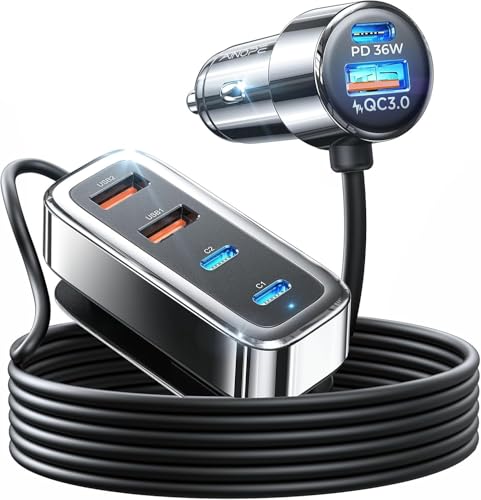
- Six USB-C and USB-A ports
- 5-foot cable reaches the back seat
- Works with 12V–24V vehicles
Best For: Families and groups charging devices in multiple rows
Best for AC Power

- Two AC outlets and four USB ports
- 18W QC and 20W USB-C charging
- Compact vehicle-friendly design
Best For: Road trips requiring AC outlets for small electronics
Best Fast-Charging Layout

- Three USB-C and three USB-A ports
- Up to 35W USB-C or 30W USB-A individually
- 5-foot cable with rear-seat clip
Best For: Families sharing USB-C and USB-A charging across two rows
Best Compact Inverter
PiSFAU 200W Car Power Inverter

- Two AC outlets plus four USB ports
- 12V DC to 110V AC conversion
- Compact 8.8-ounce design
Best For: Travelers needing AC and USB power in a compact package
Best for Big Groups
5-Port DEWALT Road-Trip Charger

- Five USB ports for simultaneous charging
- PD 30W and QC 3.0 front ports
- 6-foot rear-seat cable with metal clip
Best For: Families and groups charging devices across the cabin
Best Compact Two-Pack
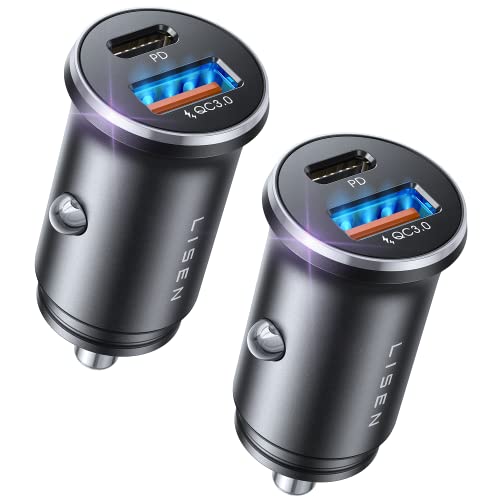
- USB-C PD and USB-A QC ports
- Small flush-fitting aluminum design
- Two adapters included for backup or two cars
Best For: Drivers wanting a tidy two-device charging setup
Best All-in-One Setup
DreamBee 108W Retractable Charger

- Built-in retractable cables and extra ports
- Supports up to six devices simultaneously
- Voltage display and 12V/24V compatibility
Best For: Mixed-device groups that want organized in-car charging
Top Power Pick

- Up to 130W with PPS, PD, and QC support
- Three ports for charging devices together
- 12V-24V compatibility with voltage display
Best For: Families and road trippers needing high-output charging
Best Four-Port Layout
90W USB-C and USB-A Car Charger

- Four ports: dual USB-C and dual USB-A
- Up to 90W with a 30W USB-C PD port
- Safety features and 12V-24V vehicle support
Best For: Groups carrying a mix of USB-C and USB-A devices
Best Family Pick – AINOPE 108W 6-Port Car Charger
For families comparing car usb chargers for road trips, the AINOPE 108W charger stands out with six ports and a 5-foot extension cable. It supports front- and rear-seat charging, making it a practical choice for SUVs and other vehicles carrying several passengers.
Best For: Families and groups that need simultaneous charging in both rows of the vehicle.
Pros:
- Six total USB-C and USB-A ports for multiple devices.
- 5-foot cable helps reach rear-seat passengers.
- Built-in protections guard against over-current, overheating, overcharging, and short circuits.
- Compatible with 12V–24V vehicles, including cars, SUVs, trucks, and RVs.
Cons:
- The supplied specifications list different total-wattage figures, so output sharing may require checking the product details.
- Its multi-port design may be more than a solo traveler needs.
Choose this AINOPE model when keeping several passengers powered is more important than having the smallest possible charger. The long cable and six-port layout are especially useful on extended family drives.
Best for AC Power – YSOLX 200W Car Power Inverter
If your road-trip setup includes laptops or other plug-in electronics, this 200W inverter is a useful alternative to standard car usb chargers for road trips. It converts 12V DC power to 110V AC and adds two AC outlets plus four USB ports in a compact housing.
Best For: Travelers who need both AC outlets and USB charging from a vehicle power socket.
Pros:
- Provides two US-standard AC outlets and four USB ports.
- Includes 18W USB-QC and 20W USB-C charging.
- Compact 5 x 2.7 x 1.4-inch design weighs about 8.5 ounces or more.
- Protection system covers over-voltage, overload, overheating, under-voltage, and short circuits.
Cons:
- Its 200W capacity is intended for small electronics, not high-power appliances.
- Uses a modified sine wave output.
This YSOLX inverter makes sense when a trip calls for conventional AC plugs as well as USB charging. Its small size is convenient, but users should stay within the stated 200W output limit.
Best Fast-Charging Layout – Rocoren 105W 6-Port Charger
The Rocoren 105W charger is designed for travelers who want fast charging distributed across both rows. Among car usb chargers for road trips, its three USB-C and three USB-A ports offer a flexible mix for phones, tablets, power banks, and other devices.
Best For: Families needing a dedicated front-and-rear charging arrangement with USB-C and USB-A support.
Pros:
- Six ports include three USB-C PD3.0 and three USB-A QC4.0+ connections.
- 35W USB-C and 30W USB-A output when individual ports are used.
- 5-foot extension cable and rear clip help position the charger for back-seat passengers.
- Compatible with 12V–24V vehicles and includes multiple charging protections.
Cons:
- Maximum individual-port output does not mean every port delivers its maximum simultaneously.
- Some listed MacBook compatibility is limited to 24V vehicles such as trucks.
Rocoren is a strong fit when passengers use a mixture of USB-C and USB-A devices. The rear clip and extension cable make its six-port arrangement easier to use in a family vehicle.
Best Compact Inverter – PiSFAU 200W Car Power Inverter
For road trips that need more than phone charging, the PiSFAU 200W inverter combines two AC outlets with four USB charging ports. It is a compact option alongside car usb chargers for road trips, particularly when you need to power small laptops, tablets, phones, or lights from a 12V vehicle socket.
Best For: Travelers wanting a small inverter with AC outlets, USB charging, and basic protection features.
Pros:
- Offers two AC outlets and four USB charging ports.
- Converts 12V DC vehicle power to 110V AC.
- Compact 5 x 2.7 x 1.4-inch form factor weighs about 8.8 ounces.
- Includes protection against overheating, under-voltage, over-voltage, overload, and short circuits.
Cons:
- Limited to a 200W output, so it is intended for smaller electronics.
- Its modified sine wave output may not suit every AC-powered device.
The PiSFAU is a practical space-saving choice when a trip needs both plug-in AC power and USB charging. Keep connected equipment within the 200W limit for the intended use.
Best for Big Groups – 5-Port DEWALT Road-Trip Charger
For families or groups comparing car usb chargers for road trips, the DEWALT DXMA1410475 stands out with five USB ports and a separate back-seat charging setup. It combines front-seat PD 30W and QC 3.0 charging with three rear-seat ports connected by a 6-foot coiled cable.
Best For: Families, groups, SUVs, trucks, and RVs that need to charge several devices throughout the cabin.
Pros:
- Five total USB ports support simultaneous charging.
- Includes front-seat PD 30W and QC 3.0 ports.
- Six-foot Kevlar-reinforced cable and metal clip help reach and secure the back-seat charger.
- Safety features address over-current, overcharging, overheating, and short circuits.
Cons:
- The separate back-seat unit uses a visible connecting cable.
- Its multi-port design may be more than a solo driver needs.
This is a practical choice when keeping multiple passengers powered matters more than having the smallest possible adapter. Its front-and-back-seat layout is especially useful on long drives.
Best Compact Two-Pack – LISEN 69W Dual-Port Charger
For drivers who prefer a tidy setup, this LISEN charger is a compact option among car usb chargers for road trips. Each adapter has a USB-C PD port rated up to 36W and a USB-A QC port rated up to 18W, with an aluminum shell designed for heat dissipation.
Best For: Solo drivers, couples, or households that want one compact charger per vehicle or a convenient backup.
Pros:
- USB-C and USB-A ports cover many current phones, tablets, and accessories.
- Small, flush-fitting design helps reduce dashboard clutter.
- Aluminum-alloy construction is designed to dissipate heat.
- Two-pack offers a charger for two cars or a spare.
Cons:
- Only two devices can be connected per adapter.
- It is less suitable for large groups needing several charging connections at once.
The LISEN is a sensible road-trip pick when simplicity and a clean interior are priorities. The two-pack adds flexibility without requiring a larger multi-port hub.
Best All-in-One Setup – DreamBee 108W Retractable Charger
The DreamBee combines built-in retractable cables and extra ports for travelers comparing car usb chargers for road trips. It includes dual 30W USB-C retractable cables, an 18W iOS retractable cable, USB-C and USB-A ports, and a voltage display for monitoring the vehicle’s electrical system.
Best For: Road trippers who want built-in cable storage and charging options for several mixed-device users.
Pros:
- Six-in-one design supports up to six devices simultaneously.
- Retractable 31.5-inch cables help limit tangles and clutter.
- Voltage display provides at-a-glance vehicle battery information while charging.
- Supports 12V and 24V systems and multiple fast-charging protocols.
Cons:
- The retractable cables are built in, so they cannot be swapped for different cable types.
- It is for charging only and cannot be used for CarPlay.
- The feature-rich design may be unnecessary for drivers charging only one or two devices.
This is the most versatile option of the three for mixed-device travel. Its retractable cables reduce loose cords, while the extra ports make it useful when several passengers need power at once.
Top Power Pick – 130W 3-Port USB-C Car Charger
For shoppers comparing car usb chargers for road trips, this 130W adapter stands out for its high output and three-port design. It includes two USB-C ports and one USB-A port, with intelligent power distribution for charging phones, tablets, and accessories together.
Best For: Families, truck and RV owners, or travelers who need fast charging for multiple devices.
Pros:
- Up to 130W total output with PPS, PD, and QC support.
- Charges three devices simultaneously through two USB-C ports and one USB-A port.
- Works with 12V-24V vehicles, including cars, trucks, SUVs, and RVs.
- Metal housing, voltage display, and over-current and short-circuit protection add practicality for long drives.
Cons:
- Maximum charging speed depends on the connected devices and power distribution.
- Its feature set may be more than needed for a single-phone commuter setup.
This is the strongest choice when charging speed, broad vehicle compatibility, and simultaneous device support matter most. The voltage monitor is also useful for drivers who want a quick view of vehicle voltage during extended travel.
Best Cable Convenience – 4-in-1 Retractable Car Charger
Among car usb chargers for road trips, this 4-in-1 model is designed to reduce cable clutter. It combines retractable USB-C and Lightning cables with USB-A and USB-C ports, making it convenient when passengers bring different devices.
Best For: Families and travelers who want built-in cables and a tidier car interior.
Pros:
- Includes two 31.5-inch retractable cables plus USB-A and USB-C ports.
- Supports simultaneous charging for phones, tablets, dash cams, Switch devices, and other electronics.
- Real-time voltage display helps monitor vehicle voltage.
- 180-degree adjustment and 12V-24V compatibility suit many cars, SUVs, trucks, and buses.
Cons:
- It is for charging only and does not support CarPlay, Bluetooth, or data transfer.
- Charging output varies depending on how many devices are connected.
- It requires a standard cigarette-lighter socket and is not intended for USB-only vehicles.
The retractable cables are the main reason to choose this charger. It is especially practical for shared vehicles where loose cables become inconvenient, though buyers who need a specific high-wattage output should review their device requirements.
Best Four-Port Layout – 90W USB-C and USB-A Car Charger
This 90W adapter is a practical option for car usb chargers for road trips when several passengers need power. Its four-port layout combines dual USB-C and dual USB-A connections, with separate output combinations for phones, tablets, GPS units, cameras, and other electronics.
Best For: Multi-passenger trips and drivers carrying a mix of USB-C and USB-A devices.
Pros:
- Offers four charging ports: two USB-C and two USB-A.
- Supports up to 90W maximum output, including a 30W USB-C PD port.
- Compatible with 12V-24V vehicles and a wide range of phones, tablets, laptops, GPS devices, and cameras.
- Includes heat-dissipation vents, anti-slip contact design, and multiple safety protections.
Cons:
- Port output is not identical across all four connections.
- The 90W maximum is shared according to the charger’s stated port layout.
- Its 12-month warranty is shorter than the two-year coverage listed for the retractable model.
This charger makes sense for a mixed-device vehicle because it preserves both USB-C and USB-A flexibility. Check the port-specific wattage before connecting a laptop or other higher-demand device, particularly when several ports are occupied.
How We Picked the Best Car USB Chargers for Road Trips
We focused on the features that matter during extended travel: total output, USB-C and USB-A port selection, charging speed, passenger capacity, fit, cable convenience, and versatility. The lineup includes straightforward multi-port chargers for phones, as well as power inverters for travelers who need an AC outlet or higher-capacity charging options.
Because advertised wattage can be shared across ports, we treated total output as a starting point rather than a guarantee that every device will charge at maximum speed simultaneously. Compatibility with your phone, tablet, laptop, or other gear remains essential.
Quick Comparison
- Best for several phones: Choose a multi-port charger with both USB-C and USB-A connections.
- Best for fast USB-C charging: Look for PD or PPS support and enough dedicated wattage for your device.
- Best for families: Six-in-one or five-port designs reduce disputes over available outlets.
- Best for laptops and AC accessories: Select a 12V-to-110V power inverter, while checking its continuous-wattage rating.
- Best for a tidy cabin: Retractable-cable models can reduce loose cords, but verify cable length and connector types.
Key Buying Factors for Car USB Chargers for Road Trips
Output and Charging Standards
USB-C Power Delivery is generally the most useful feature for newer phones, tablets, handheld consoles, and some laptops. PPS can improve compatibility with devices that support adaptive fast charging. USB-A remains valuable for older cables and accessories. Check both the maximum output of the charger and the output assigned to each port.
Port Count and Device Mix
Count the devices you expect to charge at once, including wireless headphones, cameras, navigation units, and power banks. A four-port charger may be sufficient for two travelers, while larger families may benefit from five- or six-connection designs.
Inverter Capacity and Safety
Power inverters are more versatile than USB-only adapters, but they are larger and may include cooling fans. Compare continuous power, peak power, outlet style, USB ports, fuse protection, and the requirements of the device you plan to plug in. Avoid exceeding your vehicle’s 12V socket rating.
Fit, Cables, and Everyday Usability
Make sure the adapter sits securely in the cigarette-lighter socket and does not interfere with nearby controls. Built-in or retractable cables are convenient, but removable cables are easier to replace. Look for overcurrent, overvoltage, overheating, and short-circuit protection.
Who Should Buy Which Car USB Chargers for Road Trips?
Solo drivers who mainly charge one phone should choose a compact USB-C PD adapter. Couples and families should prioritize multiple ports and balanced output so passengers can charge simultaneously. Travelers carrying older USB-A devices should select a mixed-port model. If your trip includes a laptop, camera battery charger, or small AC accessory, a properly rated power inverter is the better choice. For frequent road trippers who dislike tangled cables, a retractable model offers convenience, provided its integrated connectors match the devices in your vehicle.