Choosing the right solar charge controller for a LiFePO4 battery affects charging safety, solar harvest, and system reliability. The best option depends on your battery voltage, panel array, charging current, and whether you prefer simple PWM control or more efficient MPPT technology.
These 10 selected controllers cover common 12V and 24V setups, with features such as Bluetooth monitoring, LCD displays, USB-C ports, waterproof construction, and support for multiple battery chemistries.
Best 10 Solar Charge Controller for Lifepo4 Picks for 2026
Best Value Smart PWM
30A LiFePO4 Solar Charge Controller
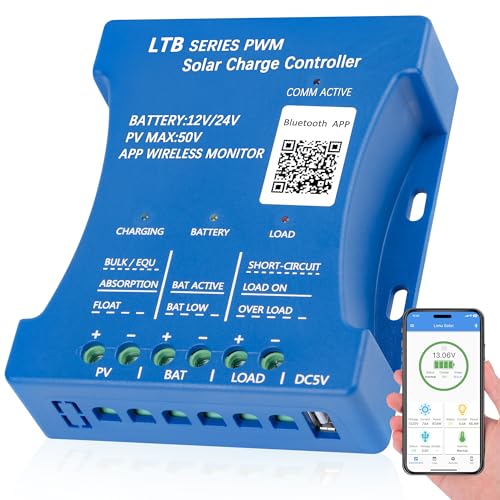
- Bluetooth APP monitoring and setup
- Supports LiFePO4 plus four other battery types
- Seven load modes and USB output
Best For: Flexible small solar systems needing app control
Best Established MPPT Option
Victron SmartSolar 15A MPPT Controller

- Efficient MPPT tracking for available sunlight
- Bluetooth monitoring through VictronConnect
- Supports synchronized multi-controller charging
Best For: Compact systems prioritizing efficient, connected charging
Best Simple 12V Choice
SUNAPEX 20A LiFePO4 PWM Controller

- Dedicated 12V LiFePO4 charging support
- LCD voltage and current monitoring
- USB and Type-C device outputs
Best For: Small 12V systems under 300W
Best Budget PWM Pick
12V 20A LiFePO4 Solar Controller

- 12V, 20A PWM charging for LiFePO4, AGM, and Gel batteries
- 20W USB-C PD and 18W USB fast charging
- LCD monitoring with six safety protections
Best For: Compact 12V RV, camping, marine, and off-grid systems
Best MPPT Upgrade
BougeRV 40A LiFePO4 Solar Controller

- 40A MPPT charging for 12V and 24V systems
- Low-temperature cutoff and LiFePO4 activation support
- App control, LCD display, and up to 99.5% tracking efficiency
Best For: Larger RV, marine, and off-grid systems needing efficiency and monitoring
Best Easy-Install PWM Pick
12V 20A LiFePO4 Solar Controller
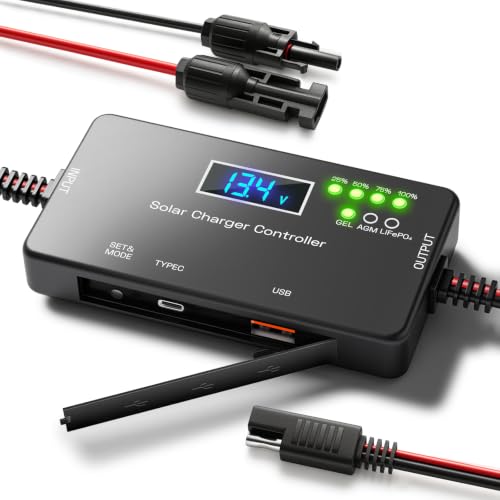
- 12V 20A PWM charging with support for panels up to 300W
- Quick-connect wiring and bright LCD battery readout
- 22W USB-C PD and 18W USB QC3.0 charging
Best For: Simple RV, boat, shed, and camping installations
Best All-Weather Pick
SUNAPEX 12V 20A Waterproof Controller

- 20A capacity for 20W–240W panels
- IP68 waterproof outdoor housing
- Supports LiFePO4 and several lead-acid types
Best For: Weather-exposed 12V RV, boat, and off-grid systems
Best Efficiency Pick

- MPPT tracking rated up to 99% efficiency
- USB-C, USB-A, and LCD monitoring
- Plug-and-play SAE connector installation
Best For: Compact 12V mobile and off-grid solar systems
Best Versatile Capacity
Peidesi PWM 30A 12V/24V Controller

- Automatically supports 12V or 24V systems
- 30A PWM capacity with LCD controls
- Supports LiFePO4 and multiple battery types
Best For: Larger RV, camping, home, and commercial solar setups
Best Value Smart PWM – 30A LiFePO4 Solar Charge Controller
If you need a practical solar charge controller for LiFePO4 batteries, this 30A PWM model offers broad battery compatibility, Bluetooth APP monitoring, and automatic 12V/24V detection for non-lithium systems. Its USB output and configurable load modes add useful flexibility for smaller off-grid setups.
Best For: Users wanting app-based monitoring and versatile load controls in a budget-friendly PWM controller.
Pros:
- Supports LiFePO4, lithium, sealed, gel, and flooded batteries.
- Bluetooth APP provides real-time system monitoring and configuration.
- Includes seven load modes and a 5V/1.5A USB output.
- Built-in protections include overcurrent, short-circuit, overheating, and reverse connection protection.
Cons:
- PWM technology is generally less efficient than MPPT charging.
- Automatic voltage matching is specified for non-lithium batteries; verify settings for LiFePO4 use.
- Correct connection order is required, beginning with the battery.
This controller is a flexible choice when app access and multiple load schedules matter more than maximum panel-harvesting efficiency. Confirm battery settings and wiring before installation.
Best Established MPPT Option – Victron SmartSolar 15A MPPT Controller
For shoppers seeking a proven solar charge controller for LiFePO4 batteries, the Victron SmartSolar MPPT 75V/15A emphasizes efficient energy harvesting and connected monitoring. Its MPPT tracking, Bluetooth app, and configurable load output make it suitable for compact 12V or 24V systems.
Best For: Compact installations where MPPT performance, app connectivity, and synchronized charging are priorities.
Pros:
- MPPT tracking is designed to maximize available solar power, including in partial shade.
- VictronConnect provides real-time data, 30-day history, settings, firmware updates, and alarms.
- Multiple units can synchronize charging stages across a system.
- Configurable load disconnect helps protect batteries from excessive discharge.
Cons:
- The 15A rating is suited to smaller systems than the 40A alternative in this roundup.
- The supplied notes do not explicitly list a LiFePO4-specific charging profile.
- It has a minimal LED-style display rather than a full onboard LCD.
Victron’s strongest advantages are efficient MPPT operation and a mature monitoring ecosystem. Before buying specifically for LiFePO4, confirm the appropriate battery preset or charging settings in VictronConnect.
Best Simple 12V Choice – SUNAPEX 20A LiFePO4 PWM Controller
This 20A unit is a straightforward solar charge controller for LiFePO4 batteries in 12V setups. It combines an LCD status display, selectable battery modes, dual USB and Type-C outputs, and protective circuitry, while supporting solar panels below 300W.
Best For: 12V solar users who want a clearly specified LiFePO4 mode and convenient device charging.
Pros:
- Designed specifically for 12V batteries and supports LiFePO4, AGM, gel, and lead-acid types.
- LCD shows system information, including battery voltage and current.
- Type-C and USB outputs can power compatible electronics.
- Four-stage charging and protections address overcharge, reverse current, short circuits, and overheating.
Cons:
- Not compatible with 24V or 36V battery packs.
- Limited to solar panels below 300W.
- Correct polarity and connection order are essential; the unit does not include a polarity converter.
Choose the SUNAPEX when your system is firmly 12V and you value simple local status checks and built-in device charging. Its fixed voltage limitation makes system compatibility especially important.
Best High-Capacity MPPT – Redodo 40A LiFePO4 Controller
For larger installations, the Redodo 40A MPPT is a capable solar charge controller for LiFePO4 batteries, with automatic 12V/24V operation, up to 100V PV input, and substantial panel capacity. Built-in Bluetooth, an LCD, and an included remote temperature sensor support more detailed system management.
Best For: RV, home, off-grid, and DIY systems needing higher charging capacity and MPPT efficiency.
Pros:
- 40A MPPT design offers up to 600W at 12V or 1,200W at 24V according to the supplied details.
- LiFePO4 charging mode is enabled by default and other battery profiles can be selected.
- Supports up to 100V PV input with stated tracking efficiency up to 99%.
- Bluetooth, LCD controls, RS485 connectivity, and a remote temperature sensor provide monitoring flexibility.
Cons:
- Its larger capacity and enclosure may be excessive for small solar arrays.
- The supplied dimensions and 4.4-pound weight suggest a less compact installation than smaller controllers.
- Panel voltage and wattage limits still need to be matched carefully to the system.
The Redodo stands out when a LiFePO4 system needs more charging headroom than a compact controller can provide. Its MPPT design and monitoring options make it a strong fit for larger arrays, provided the PV input stays within specification.
Best Budget PWM Pick – 12V 20A LiFePO4 Solar Controller
If you need a straightforward solar charge controller for LiFePO4 in a 12V RV, marine, camping, or off-grid setup, this 20A PWM model covers the essentials. It supports LiFePO4, AGM, and Gel batteries and solar panels up to 250W, but it is not designed for 24V or 36V systems.
Best For: Budget-conscious users building a compact 12V solar system with convenient USB device charging.
Pros:
- Supports 12V LiFePO4, AGM, and Gel batteries with up to 20A charging.
- Includes 20W USB-C PD and 18W USB fast-charging ports.
- LCD voltage monitoring, reverse-current protection, and six safety protections.
Cons:
- Limited to 12V battery systems and 250W solar panels.
- PWM charging is less efficient than MPPT charging in many installations.
- No SAE-to-bare-wire cable or polarity adapter is included.
This is a practical choice for smaller 12V systems where simple monitoring, low idle drain, and built-in device charging matter more than maximum solar-harvesting efficiency.
Best MPPT Upgrade – BougeRV 40A LiFePO4 Solar Controller
For shoppers seeking a higher-capacity solar charge controller for LiFePO4, the BougeRV Sunflow 40A MPPT model supports both 12V and 24V systems. Its low-temperature charging cutoff, app control, and high-efficiency tracking make it suited to larger or more closely monitored solar installations.
Best For: 12V or 24V LiFePO4 systems that benefit from MPPT efficiency, low-temperature protection, and remote monitoring.
Pros:
- 40A adjustable charging with up to 99.5% tracking efficiency and 99% peak conversion efficiency.
- Low-temperature cutoff helps protect LiFePO4 batteries below 32°F.
- Supports app control, a backlit LCD, and solar input up to 95V.
- Six protection features and an aluminum heat sink support full-load operation.
Cons:
- Its 4-pound build and larger dimensions may be excessive for very small systems.
- Rated load current is 20A, despite the controller’s 40A charging capacity.
- Users may need to confirm which of the two supported app versions applies to their unit.
With support for up to 600W of PV power on 12V systems and 1,200W on 24V systems, this is the most capable option in the group, particularly for users who want room to expand.
Best Easy-Install PWM Pick – 12V 20A LiFePO4 Solar Controller
This 12V 20A PWM solar charge controller for LiFePO4 focuses on simple installation and clear status feedback. It supports LiFePO4, AGM, and Gel batteries, handles solar panels up to 300W, and adds USB-C and USB fast-charging ports for outdoor devices.
Best For: RV, boat, shed, and camping users who want quick-connect wiring and easy-to-read battery information.
Pros:
- Compatible with 12V LiFePO4, AGM, and Gel batteries and panels up to 300W.
- Quick-connect ports are designed for simple, secure installation.
- Bright LCD shows voltage and 25%, 50%, 75%, and 100% battery levels.
- Offers 22W USB-C PD, 18W USB QC3.0, and six safety protections.
Cons:
- Not compatible with 24V or 36V battery systems.
- As a PWM controller, it does not provide MPPT tracking.
- Plastic construction may be less suitable for demanding installations than heavier-duty designs.
The combination of quick-connect wiring, clear battery-level readouts, and strong USB output makes this a convenient everyday controller for smaller 12V setups.
Best All-Weather Pick – SUNAPEX 12V 20A Waterproof Controller
If you need a solar charge controller for LiFePO4 in an outdoor 12V setup, the SUNAPEX combines 20A charging capacity with an IP68 waterproof housing. It supports solar panels from 20W to 240W and provides a clear LCD readout for everyday monitoring.
Best For: RVs, boats, trailers, cabins, sheds, and other weather-exposed 12V solar systems.
Pros:
- Supports LiFePO4, AGM, Gel, Flooded, and Sealed Lead-Acid batteries.
- IP68 housing helps protect against rain, dust, and moisture.
- 20A capacity supports 20W to 240W solar panels.
- LCD, USB, and USB-C outputs add convenient monitoring and device charging.
Cons:
- Designed only for 12V systems, not 24V or 36V setups.
- Its USB and USB-C ports are intended for compatible small electronics rather than high-power loads.
The SUNAPEX is a practical choice when weather resistance and higher 12V capacity matter most. Confirm your battery voltage and panel wattage before installation.
Best Efficiency Pick – MPPT 12V 10A LCD Controller
For shoppers seeking a solar charge controller for LiFePO4 with maximum energy tracking, this 12V 10A MPPT model is designed to improve solar harvest over traditional PWM controllers. Its LCD, USB-C output, and plug-and-play SAE connectors suit compact mobile and off-grid systems.
Best For: Small 12V RV, boat, cabin, trailer, and backup solar installations where MPPT efficiency is a priority.
Pros:
- Advanced MPPT tracking is rated at up to 99% efficiency.
- Supports LiFePO4, AGM, Gel, Flooded, and Sealed Lead-Acid batteries.
- LCD shows battery voltage, charging current, and solar status.
- USB-A and USB-C outputs plus upgraded SAE connectors simplify everyday use.
Cons:
- Its 10A rating is suited to smaller systems than a 20A or 30A controller.
- The supplied notes specify a 12V model rather than a 24V system option.
This controller stands out for compact systems that can benefit from MPPT tracking and straightforward installation. The included 1-year warranty and technical support are useful additions for first-time setups.
Best Versatile Capacity – Peidesi PWM 30A 12V/24V Controller
The Peidesi is a flexible solar charge controller for LiFePO4 systems because it automatically supports either 12V or 24V battery setups. Its 30A PWM design, adjustable LCD controls, and dual USB 5V outputs make it suitable for larger panel configurations and varied installation types.
Best For: Camping, RV, home, industrial, and commercial systems needing 12V/24V compatibility and a 30A rating.
Pros:
- Automatically supports both 12V and 24V systems.
- 30A rating accommodates systems using 100W, 200W, or 300W solar panels as described.
- Supports lead-acid, LiFePO4, and ternary lithium batteries.
- Large LCD displays system data and allows mode and parameter adjustments.
Cons:
- Uses PWM charging rather than MPPT tracking.
- Installation requires connecting the battery first, then the solar panel, and finally the load.
- The supplied notes list protection features but do not specify waterproof certification.
Choose the Peidesi when voltage flexibility and a higher 30A capacity are more important than MPPT efficiency. Follow the stated connection order and verify your battery chemistry before configuring the controller.
How We Picked the Best Solar Charge Controller for Lifepo4
We compared the selected models by battery compatibility, charging technology, rated current, voltage range, monitoring features, installation flexibility, and stated protection features. We also considered the needs of different systems, from small portable panels and RV batteries to larger 24V arrays.
Because LiFePO4 batteries have different charging requirements from lead-acid batteries, we prioritized controllers that explicitly support lithium or LiFePO4 charging profiles. Buyers should still verify the manufacturer’s voltage settings and battery-management-system requirements before installation.
Quick Comparison
- Best for efficiency: MPPT controllers generally harvest more energy than PWM models, especially when panel voltage is substantially higher than battery voltage.
- Best for simple systems: PWM controllers are often affordable and practical for small, closely matched 12V solar panels and batteries.
- Best for monitoring: Bluetooth or LCD-equipped models make it easier to check charging status, voltage, and battery performance.
- Best for higher-power arrays: Look for higher current ratings and sufficient maximum PV input voltage, such as 40A controllers designed for larger systems.
Key Buying Factors for a Solar Charge Controller for Lifepo4
Battery Voltage and Charging Profile
Match the controller to a 12V or 24V battery bank. Confirm that its lithium setting uses suitable LiFePO4 charging behavior and that equalization can be disabled when required. A compatible BMS remains essential; the controller is not a replacement for battery protection electronics.
PWM Versus MPPT
PWM is usually the lower-cost choice for compact systems where panel and battery voltages closely match. MPPT is typically the better Solar Charge Controller for Lifepo4 when panels operate at higher voltage, temperatures vary, or maximum energy production matters.
Current and Panel Limits
Choose a controller whose rated charging current exceeds your expected solar output with reasonable headroom. Check both maximum PV voltage and maximum PV wattage, not just the headline amp rating. Exceeding either limit can damage the controller.
Monitoring, Protection, and Installation
Bluetooth and LCD displays are useful for troubleshooting and confirming charge stages. Also look for reverse-polarity, overcurrent, overtemperature, and overcharging protection. Verify wiring-gauge recommendations, fuse requirements, terminal capacity, and whether the enclosure is genuinely suitable for outdoor exposure.
Who Should Buy Which Solar Charge Controller for Lifepo4?
Choose a compact 10A or 20A PWM model for a small 12V battery, modest panel, and budget-focused installation. A 30A PWM controller suits larger basic 12V or 24V systems when panel and battery voltages are well matched.
Choose a 10A or 15A MPPT model for small systems where efficiency and improved energy harvest justify the added cost. A 40A MPPT controller is better suited to larger arrays, 24V battery banks, or users planning to expand. Bluetooth is worthwhile when the controller is installed out of sight, while an LCD is convenient for quick local checks. For exposed installations, prioritize documented weather resistance and use appropriate fusing, cable protection, and ventilation.