Choosing the right solar charge controller can improve battery life, charging efficiency, and overall system reliability. The options below cover compact 12V setups, RV kits, lithium-compatible systems, and larger off-grid installations.
We compare PWM and MPPT designs, voltage ranges, current capacity, monitoring features, and installation flexibility so you can match a controller to your panels and battery bank.
Best 10 Solar Charge Controller for Off Grid Picks for 2026
Best Overall
Victron Energy SmartSolar MPPT 100/50

- MPPT tracking helps maximize available solar power
- Bluetooth app supports monitoring and configuration
- 12V/24V, 50A design with synchronized charging support
Best For: Off-grid systems needing smart monitoring and efficient MPPT charging
Best Complete Kit
ECO-WORTHY 200W Solar Panel Kit

- Includes 200W of panels and a 30A PWM controller
- Supports series 24V or parallel 12V connections
- Comes with brackets and solar cables
Best For: Small RV, cabin, camper, and backup-power installations
Best High-Capacity Option

- Supports 12V to 96V systems automatically
- 120A MPPT design with up to 230V solar input
- LCD provides charging and diagnostic information
Best For: Large, expandable off-grid systems with varied voltage requirements
Best Compact PWM

- Compact 12V, 30A PWM controller
- Supports lithium, AGM, gel, and flooded batteries
- Includes core protections and LED status indicators
Best For: Space-limited RV, boat, and small off-grid systems
High-Capacity MPPT Pick
100A 250V MPPT Solar Charge Controller

- 250V PV input and up to 5,200W at 48V
- 12V–48V auto recognition
- Optional app monitoring and RS485 support
Best For: Large off-grid battery and solar arrays
Low-Voltage Boost Specialist
30A MPPT Solar Boost Controller
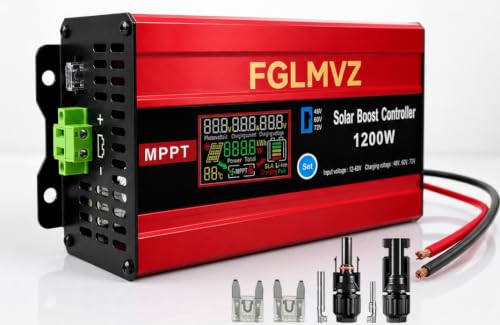
- Steps up 12–60V PV input
- Charges 48V, 60V, or 72V banks
- 1200W capacity with LCD monitoring
Best For: High-voltage batteries paired with lower-voltage panels
Best with Extra Features

- 100A charging and up to 5,600W at 48V
- 145V PV input with selectable battery profiles
- LCD monitoring and smart cooling fan
Best For: High-capacity 12V, 24V, or 48V off-grid systems
Large-System Choice
120A Wide-Voltage MPPT Controller

- Supports 12V through 96V battery systems
- Up to 11,520W PV input and 230V VOC
- User charging mode and RS485 communication
Best For: Large or expandable off-grid solar installations
Feature-Value Pick
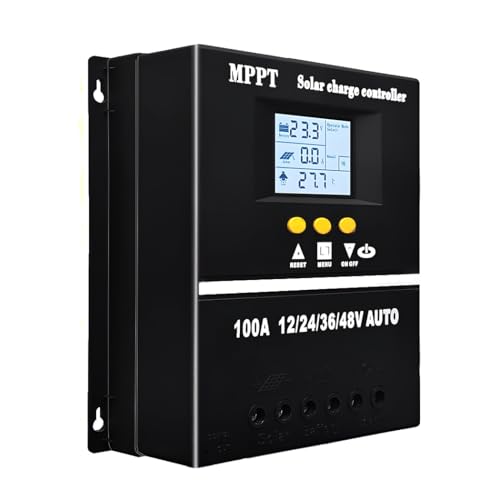
- Automatic 12V–48V system recognition
- LCD, dual USB ports, and seven operating modes
- Supports lead-acid, Gel, and LiFePO4 batteries
Best For: Convenience-focused smaller off-grid systems
Best Overall – Victron Energy SmartSolar MPPT 100/50
For shoppers seeking a dependable solar charge controller for off grid systems, the Victron Energy SmartSolar MPPT 100/50 combines fast power-point tracking, Bluetooth connectivity, and support for 12V or 24V batteries. It is a strong choice when monitoring and charge optimization matter.
Best For: Off-grid solar installations that need MPPT efficiency, app-based monitoring, and expandable synchronized charging.
Pros:
- MPPT tracking is designed to maximize available solar power, including in partial shade.
- VictronConnect provides real-time data, performance history, configuration, firmware updates, and alarms.
- Supports synchronized operation with multiple SmartSolar MPPT controllers.
- Configurable load disconnect helps protect batteries from excessive discharge.
Cons:
- No built-in display; system information is accessed through the app.
- Rated for 12V and 24V systems rather than a broad range of battery voltages.
Choose this controller if you value efficient harvesting and detailed system oversight. Its 100V, 50A specification and smart features make it particularly well suited to a thoughtfully configured off-grid setup.
Best Complete Kit – ECO-WORTHY 200W Solar Panel Kit
The ECO-WORTHY kit is a practical entry point for a solar charge controller for off grid application because it includes panels, a 30A PWM controller, mounting brackets, and cables. Its 12V/24V wiring flexibility makes it useful for several small mobile or backup-power projects.
Best For: RVs, campers, cabins, sheds, marine setups, and other buyers who want panels and controller components in one package.
Pros:
- Includes two 100W monocrystalline panels, a 30A controller, brackets, and cabling.
- Panels can be connected in series for 24V or parallel for 12V systems.
- Monocrystalline panels are rated at up to 21.5% efficiency in suitable conditions.
- Aluminum frames and an IP65-rated junction box support outdoor use.
Cons:
- The included controller uses PWM rather than higher-efficiency MPPT technology.
- Its stated daily output is based on four hours of full sunshine, so actual production will vary.
- The kit weighs 31.6 pounds and requires space for two full-size panels.
This is a convenient package for buyers who prefer a ready-to-install foundation over selecting every component separately. Confirm your battery setup and expected energy needs before choosing the included PWM controller.
Best High-Capacity Option – POWLAND 120A MPPT Controller
The POWLAND 120A MPPT is built for buyers who need a high-capacity solar charge controller for off grid systems. Its automatic support for 12V through 96V configurations, 230V maximum solar input, LCD dashboard, and broad battery compatibility give it considerable setup flexibility.
Best For: Large or varied off-grid systems requiring high charging capacity, multiple voltage options, and on-device status information.
Pros:
- Automatically supports system voltages from 12V to 96V.
- 120A charging capacity and MPPT technology target high-output installations.
- LCD shows PV input, charging stage, warnings, and diagnostics.
- Designed for LiFePO4, AGM, GEL, and flooded lead-acid batteries with multiple protections.
Cons:
- The high-capacity specification may be excessive for small solar arrays.
- The supplied notes do not specify dimensions, operating temperature, or warranty length.
- Installation should be planned carefully around the controller’s wide voltage and current capabilities.
Consider this model when scalability and broad voltage compatibility are more important than a compact, simple controller. Its LCD and protection features can make system status easier to follow, but the installation should match the substantial 120A rating.
Best Compact PWM – Renogy Wanderer Li 30A
The Renogy Wanderer Li 30A is a compact 12V PWM option for a solar charge controller for off grid use in RVs, boats, and other space-limited installations. It supports several battery chemistries, includes core electrical protections, and uses LEDs for straightforward charge-status checks.
Best For: Compact 12V RV, marine, and small off-grid systems using lithium, AGM, gel, or flooded batteries.
Pros:
- 30A PWM charging supports LiFePO4, AGM, gel, and flooded battery types.
- Three-stage charging and automatic equalization are designed to support battery maintenance.
- Built-in safeguards address reverse polarity, overcharging, overload, and short circuits.
- Compact housing supports wall or DIN-rail mounting and has an IP32 rating.
Cons:
- It is a 12V PWM controller, not an MPPT model or a multi-voltage controller.
- LED indicators provide less detailed information than an LCD or app interface.
- Bluetooth monitoring requires the separately referenced BT-1 module.
This controller makes sense when installation space and simple 12V operation are priorities. Its chemistry-specific settings and compact enclosure add versatility, while the PWM design keeps it best suited to modest systems.
High-Capacity MPPT Pick – 100A 250V MPPT Solar Charge Controller
For a large solar charge controller for off grid system, this 100A MPPT model is built for higher-voltage arrays and battery banks from 12V through 48V. Its automatic system recognition, broad battery compatibility, LCD display, and optional app monitoring make it a flexible choice when you need substantial charging capacity and system visibility.
Best For: Larger off-grid, RV, cabin, farm, marine, and backup-power systems using 12V, 24V, 36V, or 48V batteries.
Pros:
- Supports up to 250VDC PV input and up to 5,200W on 48V systems.
- Uses MPPT tracking with up to 99.9% tracking efficiency and over 98% conversion efficiency.
- Works with lithium, LiFePO4, AGM, gel, flooded, sealed lead-acid, and user-defined batteries.
- Offers LCD monitoring, optional Bluetooth app access, and RS485 Modbus support.
Cons:
- Its high-capacity design may be more than smaller off-grid systems need.
- Bluetooth monitoring requires an optional module.
- Maximum PV wattage varies by battery voltage, so array sizing requires careful planning.
This is the most capable option here for expanding an off-grid solar array. Choose it when high PV voltage, substantial charging current, and future system flexibility matter more than compact sizing.
Low-Voltage Boost Specialist – 30A MPPT Solar Boost Controller
This boost-style MPPT unit is a specialized solar charge controller for off grid installations where panel voltage may be lower than the battery bank voltage. It accepts 12–60V solar input and can step up power for 48V, 60V, or 72V battery systems, making it useful for unusual or upgraded configurations.
Best For: Off-grid systems that need to charge higher-voltage 48V, 60V, or 72V batteries from lower-voltage solar panels.
Pros:
- Boosts low-voltage solar input for higher-voltage battery banks.
- Supports lithium, LiFePO4, lead-acid, and AGM batteries.
- Provides six listed protections, including overcharge, overcurrent, short-circuit, reverse-polarity, and overtemperature protection.
- Includes a metal housing, cooling fan, aluminum heat sink, and LCD display.
Cons:
- Its output is limited to 15A, despite the 30A maximum input rating.
- It is designed for 48V, 60V, or 72V output rather than common 12V or 24V battery banks.
- Cooling hardware may add fan noise compared with simpler controllers.
The key reason to choose this controller is its boost function. It is a better match for low-panel-voltage and high-battery-voltage combinations than a conventional controller, provided the system falls within its voltage and current limits.
Budget PWM Controller – PowMr 60A 12V/24V Charge Controller
For a simpler solar charge controller for off grid setup, the PowMr 60A model supports 12V and 24V battery systems and uses four-stage PWM charging. Its adjustable parameters, LCD readout, load timer, and dual USB outputs make it practical for smaller DC-focused installations.
Best For: 12V or 24V lead-acid systems running modest DC loads in homes, workshops, or basic off-grid setups.
Pros:
- Supports 12V systems up to 780W and 24V systems up to 1,560W.
- Provides boost, absorption, equalization, and float charging stages.
- LCD shows PV, battery, and load information with adjustable voltage and timer settings.
- Includes dual 5V/2A USB outputs and multiple listed protection features.
Cons:
- Uses PWM rather than MPPT technology.
- Battery compatibility is listed for open, AGM, and gel lead-acid batteries, not lithium.
- It is limited to 12V and 24V systems, with DC-only load support.
This controller is a sensible value-oriented choice when your system uses compatible lead-acid batteries and does not require MPPT performance. Its display, adjustable settings, USB ports, and load timer add useful convenience for straightforward installations.
Best with Extra Features – 100A 48V MPPT Controller
For a high-capacity solar charge controller for off grid systems, this 100A MPPT model supports 12V, 24V, and 48V battery banks, with up to 5,600W at 48V. Its LCD, selectable battery profiles, and smart cooling make system monitoring more practical.
Best For: RVs, cabins, workshops, boats, farms, and other medium-to-large off-grid installations using compatible lithium or lead-acid batteries.
Pros:
- 100A MPPT charging with up to 99% peak efficiency and 145V maximum PV input.
- Supports LiFePO4, lithium, AGM, Gel, and compatible lead-acid batteries.
- Color LCD shows charging data, temperature, power, and cumulative generation.
- Metal wall-mount housing, temperature-controlled fan, and multiple protection functions.
Cons:
- System voltage requires manual selection rather than automatic recognition.
- Its 6.4-pound metal enclosure may require a sturdy mounting surface.
This is a strong fit when your priority is substantial charging capacity without moving beyond a 48V battery system. Confirm the PV array limits and battery charging settings before installation.
Large-System Choice – 120A Wide-Voltage MPPT Controller
This 120A unit is designed for users who need a solar charge controller for off grid systems spanning multiple battery voltages. It supports 12V through 96V systems, accepts up to 230V PV open-circuit voltage, and provides user-adjustable charging parameters.
Best For: Medium-to-large off-grid systems that need broad voltage compatibility, high PV capacity, or RS485 data communication.
Pros:
- Supports eight battery voltages from 12V to 96V.
- Handles up to 11,520W of PV input at 96V and up to 230V VOC.
- User mode allows adjustments to charging voltage, float voltage, and charging current.
- LCD display, RJ12 RS485 interface, and built-in electrical protections support system integration.
Cons:
- Its advanced voltage range and settings may be more than a small installation needs.
- Specific MODBUS commands or communication assistance require support contact.
- At 8.7 pounds, it is relatively substantial for a controller.
Choose this model when flexibility and expansion potential matter more than simplicity. Its unusually wide battery-voltage range makes it suitable for custom or upgraded systems, but careful configuration is important.
Feature-Value Pick – 100A LCD MPPT Controller
For shoppers seeking a feature-rich solar charge controller for off grid use, this 100A model offers automatic 12V, 24V, 36V, and 48V recognition, an LCD interface, dual USB ports, and several operating modes. It is aimed at users who value convenience and basic system controls.
Best For: Smaller off-grid setups using compatible lead-acid or lithium batteries, especially where USB charging and programmable lighting modes are useful.
Pros:
- Automatically recognizes 12V, 24V, 36V, and 48V systems.
- LCD displays battery voltage, PV charging current, temperature, mode, and status information.
- Includes dual 5V USB charging ports and seven operating modes.
- Supports sealed, Gel, flooded, and LiFePO4 battery charging profiles.
Cons:
- The supplied notes describe it as combining MPPT and PWM technologies rather than providing fully true MPPT functionality.
- Its plastic housing may be less durable than the metal enclosures of the other listed models.
- The notes do not specify a maximum PV wattage or input voltage.
This controller offers a practical set of convenience features at the expense of some transparency around PV input limits and MPPT performance. Verify array compatibility carefully, particularly for higher-power installations.
How We Picked the Best Solar Charge Controller for Off Grid
We selected these controllers for a range of off-grid applications, including RVs, cabins, sheds, remote workspaces, and larger battery systems. Our comparison focuses on charging technology, supported battery voltages, rated current, maximum photovoltaic input, monitoring options, and compatibility with lead-acid and lithium batteries.
MPPT models generally offer better energy harvesting, especially in cold weather, with higher-voltage panels, or when panel voltage differs substantially from battery voltage. PWM controllers remain useful for smaller, budget-conscious systems where panel and battery voltages are closely matched.
Quick Comparison
- Small 12V systems: A 20A- or 30A-rated PWM controller is often sufficient for modest panels, lighting, and basic battery charging.
- RV and portable setups: Look for simple displays, lithium support, low standby draw, and straightforward wiring.
- Higher-output arrays: MPPT controllers with higher PV voltage limits can reduce cable losses and support more flexible panel configurations.
- Large battery banks: Confirm the controller’s continuous current rating, cooling design, and compatibility with parallel controllers.
Key Buying Factors for a Solar Charge Controller for Off Grid
Controller Type
PWM is less expensive and works well for basic, smaller systems. MPPT is usually the better choice when efficiency matters, panels operate at a higher voltage, or the array will experience changing temperatures and sunlight.
Voltage and Current Ratings
Match the controller to the battery bank’s nominal voltage, such as 12V, 24V, or 48V. Size the current rating above the array’s expected charging current, while checking the manufacturer’s rules for maximum PV wattage and allowable panel open-circuit voltage. Never rely on the advertised amperage alone.
Battery Compatibility
Verify support for your battery chemistry and charging profile. Lithium batteries typically need configurable absorption, float, and low-voltage settings, while lead-acid batteries may require temperature compensation and different charge stages.
Monitoring and Installation
LCD screens, Bluetooth or app monitoring, and RS485 communications can simplify setup and troubleshooting. Also check wire-terminal size, fuse requirements, heat dissipation, enclosure placement, and whether the unit needs ventilation.
Who Should Buy Which Solar Charge Controller for Off Grid?
Choose a compact PWM model for a small 12V battery, low-wattage array, or simple lighting system where low cost and easy installation matter most.
Choose an MPPT controller for an RV, cabin, or serious off-grid installation where improved harvest, flexible panel wiring, and lithium support justify the added cost.
Choose a high-capacity MPPT unit only after calculating array wattage, battery-bank voltage, expected charging current, and PV open-circuit voltage. Oversized controllers can be useful for expansion, but every rating must still match the rest of the system.
Before purchase, compare the controller’s specifications with your panel data sheet and battery manufacturer’s charging requirements. Correct sizing, proper fusing, and safe installation matter as much as the controller’s headline rating.